Observing from beyond the solar system, a cultural outsider looks in.
Tuesday, January 20, 2009
I Never Saw So Many People Gathered to Watch C-SPAN Before
I just got back from watching the inauguration at the historic Senator Theatre. I never thought I'd see so many people gathered to watch C-SPAN. It truly IS a new day in America when that happens! The 900 seat theatre had standing room only, and a very enthusiastic crowd.
The event was organized as a food drive, so the cost of admission was canned food. It looked like a lot of food was donated, so hopefully this is a big help to the GEDCO/CARES food pantry, which reports that it is seeing a record number of clients. I think their representative at the event said demand has doubled in the past few months.
It was really NICE to see the end of the Bush administration. I loved it when Bush waved to the crowd at the end of the inauguration and people in the audience shouted "BYE!" That was a good feeling. We can all breathe a bit easier now, for sure.
Obama gave a speech that touched on many important points, and I hope he is serious about green energy and job creation, and I certainly wish him the best in turning our country around and getting us out of this grave situation. Good luck, Mr. President, because you are sure going to need it.
I also hope he's serious about really bringing people of different backgrounds together and working toward the day when we can have peace. But I've got news for him. It's a lot closer than we think. Iraq? This is a war of choice. We could lay down our arms there right now, if we wanted to. We hear less about Afghanistan, but that seems to be a similar situation.
I was disappointed to hear him start off his speech by saying we're at war with a network of haters all around the world, because I don't think that's accurate. I think we're in wars of choice in Iraq and Afghanistan. I think there are a relatively small number of criminals (terrorists) around the world who hate us, but to call our struggle with them a war is an exaggeration that serves only to keep the American people fearful, distract us from more important issues, and inflate the egos of the terrorists, probably encouraging them somewhat.
In other words, if we really want peace, when are we going to make it a priority? Because we could do that. It's a matter of choice. Obama ought to act on Dennis Kucinich's idea of a Department of Peace, as well as end the wars ASAP. And this notion of a global war on terror really is silly, so let's recognize that as well.
I was glad to hear him talk about how we don't have to give up our values and our liberties for security, and I liked his rather pointed criticism of the Bush administration, even if he didn't specify who exactly he was talking about.
So, there was a lot of hope in Obama's speech, but also a disapointing amount of same-old, same-old. Really, as far as I can tell, the terrorists are a bogey man that our leaders like to use to scare us, keep us in line, and distract us. They also use them as an excuse to start wars of choice so war profiteers can make money. I wish Obama would just admit that. But I suspect all leaders like to have an enemy they can blame when times get rough.
Anyway, with cautious optimism I will say it looks like there will be some improvements, and they are certainly needed.
In the spirit of service to the community which Obama mentioned, I don't want to forget to give a plug here for the Senator Theatre, which hosted the event. This is a real old architectural gem of a movie theatre from the 1930s. I just love the old Art Deco theatres. This is one of the few left. It also happens to be in my neighborhood, for which I am lucky.
The Senator has had a lot of trouble over the years remaining open as a historic, single-screen theatre. Right now I know they are looking at turning it into a nonprofit to keep it going. There's a community meeting there at 10:30 AM on Thursday, January 22nd. If you're in Baltimore, I hope you can make it. In the words of the theatre's web site:
Join us this Thursday, January 22nd at 10:30am for a communal call to action and express your support for The Senator remaining in operation as it transitions to become the region's premiere, community owned non-profit Arts & Entertainment Venue.
The mid to long-term prognosis for The Senator Theatre after its transition to non-profit ownership and operation appears promising, even in this economy. The immediate short-term status of the theatre,however, has become very precarious.
Like a nasty flu that sickens the healthy but can kill those who are already weak, the downturn in the economy has placed the operational status of The Senator, and its future, in great jeopardy.
To prevent a devastating shutdown, The Senator's economic viability must be quickly addressed among all those who share a vested interest in the theatre maintaining its near 70 year unbroken chain of day to day operation.
I'll try to keep blogging in this new year about what's happening with the Senator. I'd really like to see it preserved.
Well, the day the whole world has prayed for and eagerly awaited for eight years finally comes tomorrow - the end of the Bush administration. Let's all take a moment tonight to toast the fact that we survived, more or less, some of us anyway, and toast the departure of the worst president in American history and the arrival of a new president who can hardly help but be much better.
I don't have great hopes that Barack Obama is going to take the bold progressive steps that are really needed in the dire international situation we're in, but the world now has a slightly enhanced chance of survival, and that's something to be thankful for, at any rate.
On the federal holiday designated for the Reverend Martin Luther King Jr.'s birthday, we can also give thanks that tomorrow also represents the long-awaited end of another era --- the one where many people of color believed there were certain offices in this country that were off-limits to them. Now, this does not mean that the problem of racism is gone. Tomorrow's triumph is in that sense mostly symbolic, but at least I think it will inspire young kids growing up today to set their sights a bit higher than they might have otherwise.
The People's Job is to Hold Government Accountable
I just want to respond briefly to some attitudes I have been seeing a lot lately among fellow Democrats. I'm talking about "don't criticize Obama, especially before he gets into office," and "we need to move forward, not punish the Bush administration." I believe both these attitudes are wrong.
I haven't been blogging a lot, but whenever I do, I keep seeing people expressing one or both of these sentiments. Most recently, I saw it in some of the comments on a piece written by actor John Cusack on Huffington Post. Mr. Cusack proposes two questions to be asked of AG nominee Eric Holder during his confirmation process: 1. Is waterboarding torture? 2. (Paraphrasing here) Given that the correct response to question number 1 is Yes, what is Mr. Holder going to do to see that the parties responsible for condoning torture in the Bush administration are prosecuted? I heartily agree with his essay. We do need to stop torture, and the war criminals in the Bush administration need to be punished.
Now, many of the commenters on that piece gave variations of the two attitudes I described: "don't criticize Obama" or "we need to move forward." Here's why I think they're wrong:
Punishing members of the Bush administration for their crimes isn't really about looking backwards or being punitive. There are elements of that, but it's really about upholding justice and the rule of law. If Bush and Cheney get away with their crimes, what will prevent the next leader who thinks he or she is above the law from doing the same or worse? The founding fathers of the United States envisioned a government that was accountable to the people. What's more, they envisioned the people taking an active role in holding the government accountable. It's the only way our system works. Without that, a crucial piece of our system of government is missing. The people are supposed to be the ultimate check on abuse of power.
Here's where the second attitude that I'm objecting to comes in: "Fellow Democrats shouldn't criticize Obama." Say what? This is the same attitude Republicans tried to enforce about Bush. Don't criticize the President. Baloney. Democrats that have this "party loyalty uber alles" attitude have been objecting to progressives trying to push Obama to the left, or basically anyone who expects him to do anything that might inconvenience him. Again, I say baloney. Being President isn't supposed to be easy or convenient. He is supposed to be answerable to the people. We the people are supposed to be telling him what we expect of him and holding him accountable.
If he's not doing enough to investigate and prosecute Bush administration crimes, we need to let him know. If he's not doing enough to fight off economic depression by working from the bottom up, we need to let him know that too --- as some members of the Senate, such as Iowa Senator Tom Harkin, did recently (and were criticized for it by Obama loyalists). Democrats, progressives, liberals, our job to hold government accountable doesn't stop when people we elected are in power. Kudos to those who know this. To those who don't: get used to it.
I struggled with the title of this piece. I was going to call it "10 things I expect from the Obama administration," but I don't actually believe Obama will do even half of these. Nevertheless, they are all vital to the health of our nation and necessary if we are going to truly get on the right track. I considered calling it "10 things the Obama administration should do," but that minimizes the necessity of these steps. I considered calling it "10 things the Obama administration must do," but in reality, many of these things will probably not be accomplished in eight years. Nevertheless, they are the direction we must be moving.
This is my personal manifesto on the most important goals for our nation. As you read this opinion piece, remember, I don’t believe I'm asking for too much. I'm demanding the minimum I believe we all deserve from our leaders. The fact that many of these goals seem far off and nearly impossible for Obama to achieve is only evidence of how badly our previous leaders have failed us. I’m not saying these will be easy for Obama, or that he will achieve them. I’m saying they need to be goals he has clearly in sight and he must work persistently toward them.
Restore our Constitution. After eight years of the Bush administration, I don’t recognize this country anymore. We’ve seen things happen that I didn’t think could ever happen in America --- very bad things.
We’ve seen the probable theft of two elections. We’ve seen people arrested and held without due process of law and without their right of habeas corpus. We’ve seen a mockery made of our right to peaceably assemble, with protestors being confined to fenced-in “free speech zones” that look a lot like makeshift prisons. We’ve seen the phones of American citizens bugged, dissidents and journalists harassed and arrested.
We’ve seen the Patriot Act attempt to codify many of these abuses into law, although a sane Supreme Court (which we don’t have right now) could not help but find some of its provisions unconstitutional. We’ve seen the president assert a right to dictator-like executive powers and make preparations that would allow him to declare martial law and deploy the national guard against American citizens.
Those of us who have been paying attention to real events not necessarily reported by the corporate media have seen those things, anyway.
We need action to restore the Constitution in the first 100 days of the Obama administration.
We need a resounding return to the rule of law. We need Obama to give up the excessive executive powers claimed by Bush. We need an immediate legislative review of all national security legislation enacted during the Bush administration with a strict eye to restoring the Bill of Rights and the checks and balances in the Constitution.
We need an end to the nonsense about sacrificing our liberties for national security. Without our liberties, where is our nation? The truly valuable aspects of America only ever existed as revolutionary ideas about liberty and human rights in the first place. Without those ideas, America has nothing much of real value to offer the world. There is no law higher or more sacred in America than the Bill of Rights and the Constitution. We need to affirm that, cherish it, restore it, and uphold it.
Is the Constitution perfect? No. It certainly wasn’t when first enacted and, though amendments have vastly improved it, it isn’t perfect now. I can certainly see the need for additional amendments to spell out the right of each citizen to vote and have their vote counted accurately, the equality of rights for all citizens, and the facts that corporations are not persons and money is not speech. But those potential amendments largely fall into the category of “spelling things out for people who are too dim to get it and have obviously been tragically deprived of the use of a good dictionary, unfortunately including some Supreme Court Justices.”
Even in the imperfect state where it stands, the Constitution is the highest law of the land and a good basis for our society. Nobody should be above that law, including the president.
Kick the lobbyists out of Washington. Ask yourself how we got into this mess, how we got so far off track, how government officials stopped serving the public they are supposed to represent. If you think about it for long and you know how Washington works, you can’t help eventually coming to the conclusion that much of the fault lies with corporate lobbyists who are allowed by current laws to essentially bribe our elected representatives to do whatever suits their corporate clients.
Lobbyists have far more access to our elected representatives than we do. Much of the legislation enacted by Washington is written by them. Campaigns are funded by them, with the clear expectation of a return on the investment once the candidate gets elected. Lobbying firms promise well-heeled clients access to our representatives, and they can promise that because they can get it.
Former lobbyists go to work for elected officials. Former elected officials and their staff members go to work for lobbying firms. The closeness is incestuous, and it’s destroying our democracy.
Obama made a major campaign promise to clean up this mess. He needs to do that with real reforms, not just the appearance of reform.
Guarantee election integrity. In 2000, the Supreme Court prevented Florida from having a meaningful recount so the theoretically impartial Court could throw the election to their preferred candidate. In 2004, systematic voter suppression resulted in legitimate voters being thrown off voter rolls or prevented from registering, as well as absurdly long lines in Democratic precincts in Ohio. In addition, there was probably voting machine tampering in several key states.
In both cases, the election seems almost certainly to have gone to the wrong candidate. Together, these two election thefts resulted in the disaster that was our eight year long national nightmare of the Bush administration. We are in the horrible mess we’re in now because of depredation by a president who was most likely never legitimately elected --- in America, a country which prides itself on its democracy.
We must never allow another election theft.
To date, there is no nationwide voting system. The task of holding elections has been left up to states and municipalities by the Constitution. This is probably as it should be, since it prevents nationwide implementation of a fraudulent system just as much as it prevents nationwide implementation of a good system. I think, however, that it is time for some national guidelines on the minimum requirements for reliable, transparent elections.
If voting machines are to be used, they must allow the voter to vote on paper and the paper ballot must be saved in case of a recount. In case of a discrepancy, the paper ballot must be the official record, which means the paper ballots must be carefully guarded and preserved. Ballots may be counted by a machine, such as in an optical scan system, but there must be a way to verify that the counting is done correctly, otherwise the count can be changed within the machine and you’d never know it unless a manual count of the paper ballots is done.
The best way to allow verification that the counting algorithm is working correctly is to disallow proprietary source code and require open source code that can be inspected by interested parties. Proprietary source code means that a private company can keep the method they use for counting votes secret. The danger of privatization of our elections is illustrated by the incident with the chief executive of Diebold, Walden O’Dell, who in 2003 pledged to deliver Ohio to Bush. Diebold keeps its source code secret, so this could have easily been accomplished using an algorithm that would switch votes within the computer.
Open Voting Consortium is on the forefront of developing open source, voter verifiable voting systems. They should be sought out for their input on voting system implementation.
Citizens over 18 must be allowed to vote.
There need to be some stiff penalties created to punish people who deliberately prevent voter registration, purge voter rolls, and try to suppress the vote. Voting rights laws need to be given some teeth so that crimes involving voter suppression are actually punished. The right to vote can be guaranteed nationwide, and the Voting Rights Act needs to be strengthened.
Some citizens have trouble getting to the polls on election day because they must work. We should make it easy to vote by allowing early voting nationwide. Other measures to encourage participation should also be considered.
Of course there need to be safeguards to ensure that each citizen only votes once, but such safeguards must be implemented without suppressing the vote. Checking to make sure that new registrations are for real people who are citizens over 18 and then having some sort of poll book system that prevents voting twice should be sufficient to prevent fraud by ballot stuffing. Some groups have sought to suppress legitimate voting under the guise of “preventing voter fraud.” This kind of anti-democratic activity must not be tolerated.
America’s highest value is democracy. We must live up to that ideal by actively encouraging all citizens to vote. Deliberate interference with the democratic process must be punished as the worst kind of crime.
Stop the war profiteering. If there’s one good thing that’s come out of the past eight years, it may be the shattering of our illusions that American military operations are generally conducted for noble reasons like spreading democracy and releasing people from oppression. I know my own remaining illusions about this have been shattered.
The sad reality is that America too often goes to war to create economic opportunities for American corporate interests. This has been the case for many years, but the Bush administration has taken war profiteering to a whole new level by increasingly privatizing the military so that private military contractors like Halliburton and Blackwater can get an even bigger slice of the death and destruction pie.
America is a nation that kills people for profit. Yes, it’s a nasty and shocking thing to say. It’s also true. Let’s change that. Please, America, let’s collectively change that, because I can’t bear the thought of what this evil is doing to our national soul.
I know that if you haven’t already understood the fact of American war profiteering, it’s a bitter pill to swallow. Some folks are no doubt in denial about it. You may want to watch Robert Greenwald’s recent documentary Iraq for Sale, or in case you just can’t take it without some sick, dark comedy, check out John Cusack’s War, Inc. If you opt for the fictional, satiric version, though, just remember that though the details may be changed for comedic effect, at a basic level, War, Inc. is telling the truth.
Obama, like presidents before him, will be under tremendous pressure to continue the war for profit racket. It will take extreme courage and persistence to put an end to it. Nevertheless, this must be done.
Level the financial playing field and restore our nation to economic health. Rampant deregulation and letting corporations run wild in the name of a “free market” has been the Republican mantra for at least 30 years or so. It hasn’t worked. In fact, it has caused the financial crisis we’re in right now.
Let’s get one thing straight: the idea that corporations are going to naturally look out for the good of the entire nation instead of merely their own bottom lines is just silly. Nevertheless, it has been the basis of Republican policy for decades. We’re paying for that folly now.
Obama needs to lead the way to a saner economic policy that includes sensible regulation of the financial industry to rein in corporate greed. He needs to help America’s financial picture to get back in the black by working from the bottom up this time. That means finding ways to put people back to work and help them save.
He should take a cue from FDR, whose WPA policies helped end the great depression, began the work of getting America back on a sound financial footing, and lifted millions of Americans out of poverty.
Commit to an 80% reduction in carbon emissions by 2050. This is a target that should prevent the worst effects of global warming, although we are already too late to prevent all the effects of global warming. Major side benefits of this goal are the creation of green jobs and getting our country off its dependence on foreign oil. Add the fact that it seems unlikely many of us will survive without this commitment, and you’re left with no coherent argument against this goal.
The Obama Administration must make a major investment in developing clean and safe alternative energy sources, and that means major scientific research grants.
Start to make the carbon emissions reduction a reality without resorting to “clean coal" and "safe nuclear," which are currently oxymorons that will result in giveaways to the coal and nuclear industries. Now, I’m not saying that I’m unwilling to be convinced by strong scientific progress on the safety of these technologies, but neither of them is there yet, and any construction of coal-based or nuclear plants must be stopped until the technologies are safe and clean. In the case of nuclear, I doubt very much that it will ever be safe, because the half-life of nuclear waste leaves no room for human error of any kind.
Equal rights for all. Obama could not have been elected without the work done by the civil rights movement in earlier decades. It's time to fulfill the promise of the civil rights movement and guarantee equal rights for all regardless of race, gender, sexual preference, or ethnicity.
This means making the social and economic changes that will allow historically oppressed African Americans to finally climb out of poverty and disenfranchisement. That means a commitment to affirmative action, guaranteed voting rights, and excellent public education in all public schools.
It means equal pay and equal opportunity for women. This includes a commitment to women's reproductive rights, so that women can decide for themselves when it's time to make the potentially financially devastating decision to have children. It also means child care and education services to support children who are here and prevent single mothers from falling into poverty.
It means all consenting adults must have the right to marry as they choose, including all the legal and social benefits that entails. It also means hate crimes laws need some teeth, so we prevent violence against anyone based on race, gender, sexual orientation, or ethnicity.
It means we need to stop discrimination based on ethnicity or creed, too. It is not a crime to be a Muslim, an Arab, Hispanic, an atheist, or any other ethnic or belief background. Our schools need to teach tolerance and understanding of others so that we learn to assess individuals on their merits, not make judgments about them based on their ethnic background or creed.
Universal health care. Health care is a human right. Period. Every person in America needs to be guaranteed quality health care. In the end, this will be cheaper than the snarling Hydra of our current monstrous insurance-based non-system. We can debate about how to do it, but it needs to get done. For-profit health care must end. We are talking about the rights of human beings, and they are not for sale.
Restore the function of a free press. Without a free press, we can’t have an informed populace. Without an informed populace, we can’t make the right decisions about our future. A free press means all points of view can be expressed, not just those of moneyed corporate interests.
We cannot have a free press when five corporations control almost all of the media in this country and they promote or suppress stories based on what serves their other interests. These corporations are conglomerates, and that means they have financial interests in other kinds of industries besides just media and entertainment. Some of them have financial interests in military contractors, for example. Is it any wonder they conspired to sell us the Iraq war?
Restoring a free press is going to take rethinking of laws that govern the media to promote independent media outlets. It is going to take grants to develop independent media. And it is going to take some major corporate trust-busting. It won’t be easy, but a free press is a right that is guaranteed to us by the first amendment, and it must be restored.
Reverse corporate personhood. I don't expect this to happen overnight. It will take a reversal of the disastrous, wrongheaded Supreme Court decision that declared corporations are persons in the first place. That means any Supreme Court Justice that Obama picks MUST see the ridiculousness of that proposition. Luckily, they have me and my fondness for noticing absurdity.
For anyone not familiar with corporate personhood, it is the asinine legal concept that says that a corporation is a person and therefore has the same rights under the law as an individual (but not the same responsibilities, or else our prison system would be filled with tobacco companies, pharmaceutical companies, health insurance companies, and defense contractors convicted of murder). Let me show you how ridiculous the concept of corporate personhood really is.
If corporations were persons, I'd be trying to get Ben & Jerry's to marry me. After all, they share my progressive values, they taste sweet, and they don't care if I gain weight. On second thought, I don't want to marry Ben & Jerry's. They make me look fat.
As long as certain members of our society are over-concerned about the gender of people who marry, how do you assign gender to a corporation, anyway?
Let's pretend for a moment that I care about fashion and I have a particular designer whose corporation makes clothes I love. Let's say it's Vera Wang. Now, I want to marry Vera Wang's corporation, but surely with a name like Vera Wang, it's a female corporation. Looks like the proposition 8 supporters will be against that, although I'm not sure they would be any happier with a man who wanted to marry the corporate personhood of Vera Wang. Come to think of it, I don't want to marry Vera Wang, Inc. This dress makes me look fat.
There you have it. You can't invite a corporation into your home, feed it ice cream, serve it tea, or seduce it into your boudoir, no matter what your sexual preference, no matter how lucky you get, and no matter how sexy their shoes are. Therefore, corporations are NOT persons.
Putting an end to corporate personhood is essential. If you read through this list of goals, each one of them has some relationship to the fact that corporations have managed to grab way too much power over our government.
Some of these relationships are more obvious than others, but even in the case of human rights and equality issues, greedy corporate interests know that as long as we fight among ourselves and as long as our political power is held in check, we the people can’t take back control of our own government.
Our government is supposed to be a government of the people, by the people, and for the people. People may work for corporations, but corporations are not people and corporate interests should not run our government.
Well, there's the celebration out of the way. I know people all across the country are excited and celebrating. I'd like to join, but I'm afraid after the last 8 years of nightmare, all I can do is relax a little and be a bit relieved. The reality is, we have a whole heck of a lot of work in front of us and the election by itself changes almost nothing.
We still have to get our civil liberties back. We still have to end the Iraq war. We still have to do something about global warming. We still have to create universal health care. We still have to reform our electoral process so that we never see another election theft again.
Call me a pessimist, but there it is. I'm breathing a bit easier, but not celebrating yet.
Furthermore, I am appalled and upset that more than half the voters in California voted for hate. How can voters be allowed to vote to take away the rights of others? Prop. 8 MUST be overturned.
Lastly, I'm frustrated that with all the money Obama was able to raise, he didn't focus enough attention on the downticket races, so his coattails simply weren't as long as they should have been.
We should have 60 Senate seats now, and we don't. I fervently hope Jeff Merkley will finally be declared the winner in Oregon. Merkley seems like a great guy and is one of Progressive Blue's endorsed candidates. Go Merkley!
Also the Georgia Senate race is going into a runoff, so there's some chance of still getting Jim Martin in the Senate.
You know, if I sound like a glass half empty person, I really don't care. As I indicated in my non-denominational prayer for our country post, we're only beginning to come back from the brink of hell.
I wrote this recently at Progressive Blue. Well, not that recently. I forgot to crosspost it here. But, I'm doing that now, because I just saw a very encouraging sign that the Obama campaign may actually do something useful on this issue. For that, see the Keith Olbermann video at the bottom of the post.
I’ll admit it. I’ve been moping. Although I know this election is extremely important, I’ve been burnt before (we all have).
In 2004, I worked really hard for John Kerry, volunteering online every day during the general election. I did this even though I thought Kerry wasn’t a great candidate, wasn’t a strong enough progressive, wasn’t the candidate I wanted. I made financial sacrifices to donate to his campaign, too.
I worked hard, then I waited with baited breath for the election returns to start coming in. I watched those election returns as they trickled in that night. Initially, it looked like Kerry was winning, but suddenly everything started to change. By the following morning, I knew we had lost, and likely to election theft.
My suspicions have since been confirmed. Robert F. Kennedy, Jr., Bob Fitrakis, and many other activists have carefully investigated the 2004 election results, and there is clear reason to believe there was election tampering that probably changed the result.
In 2007, I worked relentlessly all year as a volunteer blogger for John Edwards, in part because I believed he had wanted to contest the 2004 election result, but had been overruled by Kerry. I felt strongly that Edwards would stand up for our rights in the event of a stolen election in 2008, especially after he made strong statements about voting rights during his campaign.
Barack Obama was eventually chosen as the nominee. Now, Obama’s been doing really well on the campaign trail, and I was impressed with his answers in the most recent debate, but he’s not always the strong progressive candidate I had hoped for. Here’s one specific complaint: I haven’t heard Obama address what he is doing to prevent a stolen election, and what he would do to contest a stolen election, if such a theft happens.
Here’s the truth. I haven’t gotten involved in the Obama campaign because I’m tired of working hard for disappointingly moderate candidates and then finding out those candidates have no backbone when the election is stolen. This is the reason I’ve been moping.
If I could talk to Barack Obama directly, here’s what I would say:
Mr. Obama, I hope you win. I know the Republicans have made a real mess of things, and we can’t afford another four to eight years of that. I’ve signed up to be a poll worker in my home city, because I want to make sure EVERY voter has the right to vote and have their vote count. But I have no illusions; I can’t make that difference alone.
Mr. Obama, all over the country you have thousands, maybe millions of people supporting your campaign. Many of them are working tirelessly for no money, even paying you for the privilege. Don’t you dare let them down.
Mr. Obama, I hope you win. But if the unthinkable happens, if you lose, don’t you dare concede until all the votes have been counted and counted fairly. If the specter of election theft haunts us again, you need to stand up. You need to stand up and demand justice. You need to stand up and demand that the will of the people be recognized. I know the many election integrity activists will stand up for our votes, but if you don’t also stand up, I fear the activists will be ignored as they were before.
Mr. Obama, I’m tired. I’ve worked hard to defeat the Bush agenda for several years now. I’m tired of working hard for politicians who don’t live up to their end of the bargain and fight for us.
Yes, I’ve signed up to be a poll worker, but that’s about all I have the energy to do. I wish you well, but I can’t get heavily involved in your campaign. I’ve been neglecting my career to support politicians who don’t live up to their end of the bargain for years now. I’ve got work to do in my own life. I need someone like you to prove to me that what you’re saying is sincere, by showing me you’re willing to fight for it. Maybe then I’ll be ready to make sacrifices again.
Mr. Obama, if you want me to believe again in the possibility of political transformation, all you have to do is show you are willing to fight for us.
I bet when I was busily supporting John Edwards in the primary, you never knew Obama would bring out my poetic side, right? Well, it's a big surprise to me, too, but apparently he does.
See, I entered a haiku poetry contest about the presidential election on Associated Content.
Come read my haikus. Unless your name is McCain, You won't regret it.
Well, I can't reprint those ones here, because the contest entry was exclusive for AC, but I can think of a few more. Just give me a minute here...
Joe Biden is swell. McCain, on the other hand, Can just go to hell.
And it rhymed, too! I don't know if that wins you extra points in haiku, or demerits. A few more...
Beggars on the streets. Folks out of work all over. McCain doesn't care.
Lipstick on a pig. Maybe Cheney looks better with feminine side.
Civil liberties Were stolen by Bush/Cheney. I want them back now.
Barack if you please Bring economic justice. People are waiting.
A friend was pointing out to me the racist subtext in the McCain/Palin campaign. Apparently we're supposed to want to save the pretty white woman from the scary black man. You can tell if you watch the ad where they claim "lipstick on a pig" was about Palin. Anyway, as a result I wrote this blog post about the real top ten campaign slogans of McCain and Obama on Progressive Blue.
Some readers may remember I was not initially thrilled with Obama, but the scarier his opponents get, the more he grows on me. Let's save America this time, OK?
Another friend forwarded me this commentary by Deepak Chopra. He says Sarah Palin is the "shadow self" acting out in opposition to the hope offered by Obama. Might be a good way to frame it for anyone who's into New Age stuff, but not politics.
I also just have to give a shout-out to my close, personal MySpace friend (yeah, right), John Cusack, who is clearly mad as heck and not going to take it anymore. I've been reading his blog, and I have to say, it's kind of nice to see this much outrage from someone who has enough celebrity to possibly get his voice heard loudly. His new movie, War, Inc., which seems to have been basically censored by corporate movie distributors, since it never made it to many cities, is due out on DVD soon. It's a satire about war profiteering. Really looking forward to that.
On Monday, the Sargent Shriver National Center on Poverty Law released its 2007 Congressional Poverty Scorecard. The President of the Center, John Bouman, noted that in states with the highest poverty rates, their congressional delegations tended to score the worst.
"Poverty is everywhere in America, but it is interesting that in states with the highest concentrations of poverty, the Congressional delegations seem least interested in supporting initiatives that fight poverty," said John Bouman, president of the Sargent Shriver National Center on Poverty Law, which released the study. "This appears deeper than simply opposing spending. A member could have opposed any of the measures we analyzed that called for new spending and still could have voted to support half of the poverty-fighting measures on our list."
"We can get the national leadership and we can get the congressional leadership we need," Edwards said. "But first voters need to be educated as to who is doing the work and who is not."
States whose delegations had the worst voting records and highest poverty rates were South Carolina, Alabama, Mississippi, Louisiana, Texas, Oklahoma, Kentucky and Arizona.
Most of the proposals that were considered for calculating the grade on the scorecard did not pass the House and Senate. The Senate in particular had trouble passing these bills due to filibusters or the threat of filibusters by Republican members. Vermont Senator Bernie Sanders, who received a grade of A+, explained as follows:
"That's something I don't think the America people understand," said Sanders on Monday, adding Republicans are "obstructing" the work of the Senate. "A lot of these votes were not yes or no on the specific bill. They were yes or no to end a filibuster."
Edwards said that progress on poverty will only come with leadership, but added that both Senator Clinton and Senator Obama have promised him that they will make poverty an issue in their campaigns and focus on it in the White House, if elected.
The report considered bills on a variety of issues affecting poverty.
The votes we selected cover a wide range of subject areas, including affordable housing, budget and tax, civil rights, early and higher education, health care, immigrants, labor, legal services, prisoner reentry, and rural poverty. In some important subject areas such as assets policy, we did not include any votes because we determined that no votes important to fighting poverty occurred in that subject area in 2007.
The report considered fourteen votes in the Senate and fifteen votes in the House. Members were scored on "yes" or "no" votes and absent votes were eliminated.
The center was able to provide a score for 92 out of 100 Senators. Eight Senators received no score because they had not participated in enough of the votes. In many cases this was because they were running for President, though one was ill and one had arrived in the Senate partway through the year. They were also able to rank 424 out of 435 House members, with the few who were not scored also not voting enough times for similar reasons.
Click here to see which bills were considered and how your own Congressional representatives did.
Health care is a human right. In my own definition of the progressive movement, I count that as a basic progressive principle.
For various reasons, from my own personal perspective, it is simply unacceptable to settle for anything less than true universal health care. Some of those various reasons are my experiences with health care in the United States, as well as those of my friends and family, some of whom have serious or chronic conditions.
In tonight's EENR for Progress, we look at why we need universal health care, proposals for universal health care, and what progressives can do to achieve it.
It's true that I feel very strongly about the need for universal health care, but I am not a health care expert. The research presented here is not comprehensive, but it is the best of my understanding to date.
Why we need universal health care
Why do we even need universal health care? Here's a quick review, just in case anyone remains blissfully unaware.
45 Million Uninsured Americans: There are 45 million uninsured American residents, nearly one in five non-elderly residents. For these people, preventive care is expensive and even major illnesses may go untreated until it is too late. An estimated 18,000 uninsured people die every year because they lack access to care, according to the Institute of Medicine. [Census Bureau, 2006; Institute of Medicine, 2002]
Tens of millions more Americans are at risk of losing coverage. One in three non-elderly Americans goes without insurance at some point over a two-year period. Some families see their claims denied or insurance cancelled after they incur large bills. Half of US bankruptcies are caused by medical expenses, even though two-thirds of bankruptcy filers had health insurance. Insured Americans also pay higher premiums – $922 on an average family policy and $341 on an average individual policy – to pay for the cost of treating the uninsured. [Families USA, 2005; LA Times, 9/16/2006; Warren et. al., 2005; Hacker, 2007]
Spiraling Health Care Costs: The U.S. health care system is needlessly expensive. Health care costs have consistently grown faster than wages for almost 50 years. Over the past six years, families have seen premiums grow by nearly 90 percent while benefits have been cut. One in four Americans say that they or a family member have had trouble paying a medical bill in the past year. More than a quarter of low- and middle-income households with credit card debt have charged medical expenses. [Kaiser Family Foundation, 2006; Demos and Access Project, 2007]
Furthermore, inadequate available and affordable health care leads people to ignore health problems, eventually turning into higher costs.
A 2007 paper from the National Bureau of Economic Research looked at retired California public employees on Medicare, and its findings contradict some of the basic assumption of the consumerist movement.
The study’s authors--from Harvard, MIT, and the University of Oregon-- found that chronically patients who are asked to shoulder more of their health care costs deferred, neglected, or opted-out of doctor’s visits and drugs when the price got too high. This short-term cost reduction led to long-term catastrophe, as their hospitalization rates were significantly higher than other patients suffering from chronic diseases. Immediate savings ultimately led to a greater—and otherwise preventable—use of more expensive care. Oops.
It's even worse for those already in poverty.
In 2003, the Center for Budget and Policy Priorities cited research from the RAND corporation that found “low-income adults and children reduced their use of effective medical care services by as much as 44 percent when they were forced to make co-payments, a much deeper reduction than occurred among those with higher incomes.”
Clearly universal health care that everyone can afford is important if we want to help lift people out of poverty and prevent the middle class from falling into poverty. Having a healthy population is also important to businesses, which would benefit from having a healthy work force, and even to national security.
Our every-man-for-himself attitude toward health care is a security threat on a par with unsecured ports. In Canada, people go see the doctor if they're sick for more than a day or two. It was this easy access to early treatment, along with the much tighter public health matrix that enables doctors to share information quickly, that allowed the country's health care system to detect the 2003 SARS epidemics in Toronto and Vancouver while they were still very localized, act within hours to stop them before the disease spread any further, and track down and treat exposed people before they got too sick to be helped. In both cases, the system worked flawlessly. The epidemic was stopped within days and quashed entirely in under a month, potentially saving of millions of lives.
In the U.S., that same epidemic might easily have gone unnoticed for critical days and weeks. If the first people to get sick were among those 75 million without adequate insurance, they probably would have toughed it out a few extra days before finally dragging their half-dead carcasses into an ER somewhere. Not only would they be much farther along in the course of the disease -- and thus at greater risk of death themselves -- every one of them could have infected dozens or even hundreds of other people in the meantime, accelerating the spread of the epidemic.
Worse: America's underfunded public health system might have taken several days to piece together the whole picture of an epidemic; and perhaps another week or two might have passed before the E. Coli conservatives in charge (having thrown out the science-based management plans thoughtfully developed by the bureaucracy) cooked up some kind of half-assed ideology-driven decision about how to proceed. (It would, of course, involve spectacular amounts of lying to the public.) By that point, tens of millions could have been infected, leading to a death toll that would make 9/11 and Katrina look like minor statistical blips.
Proposals for universal health care
All of the health care plans proposed this year by the major Democratic presidential campaigns were based on the "Health Care for America" plan proposed by Yale University political science professor Jacob S. Hacker, including the plan by John Edwards, which was the first and best of the plans proposed. Of course, any of the Democratic plans is better than the Republican plan.
The Health Care for America plan is an insurance-based system that seeks to leverage what we already have, create efficiencies, and close gaps in coverage. It's not a terrible plan. It could work to cover everyone, and there are indications that it would reduce costs.
WASHINGTON – A health care plan that combines the best elements of the current employer-based system and the Medicare model would create big savings, offer more choices and guarantee affordable coverage to all U.S. residents, according to a new cost and coverage analysis of the plan by the Lewin Group, a nationally respected nonpartisan consulting firm.
Health Care for America, developed for the Economic Policy Institute (EPI) by Yale political scientist Jacob S. Hacker, would achieve these goals and maximize consumers’ health care choices without unraveling existing health security, forcing individual to obtain coverage on their own, pressuring patients into health savings accounts or using inadequate vouchers.
Lewin estimates the proposal would cover 99.6 percent of all Americans without raising total national health spending. It would also save hundreds of billions over time – more than $1 trillion over the next 10 years – in national health spending, according to Lewin.
The argument can certainly be made that it is much more politically feasible to fix what we have already than it is to put health care for profit out of business and start from scratch. The problem with that is, what we have is really broken, and if we improve upon a shaky system, we are likely to cause that shaky system to become more entrenched.
Virtually all the gradual reforms being touted would reinforce a multi-tiered health care system with as many standards of care as there are dollars to purchase them, and further lock us into a private insurance-based model that holds our health hostage to the HMOs and big insurance companies for years to come.
The public is ahead of the politicians and policy wonks. A recent New York Times/CBS poll found that 64% said the government should guarantee health insurance for all, 55% identified it as the top domestic priority for Congress and the President.
Now that I no longer have a dog in the hunt, however, I admit that I have always favored a single-payer (Medicare for All) system, and I believe that is what we should really be striving for.
Excerpt from Michael Moore's Sicko
What Sicko taught America is that health insurance is not health care. Coverage is not care, because the holes in the coverage are large enough to slip through and die. So when Senator Obama says that he would support a Medicare for All system if we were starting from scratch, the nurses, patients, and Michael Moore can attest that we are all starting from scratch. As a nation, there is no health care system.
That's right, folks. We don't HAVE a health care system. What we have is a hodge podge of services that cover some of the people, some of the time, in some circumstances, maybe, but only if you can cut through the red tape. That's not a system. That's chaos.
Could we fill some of the gaps between services, legislate against the worst abuses, pull some of the pieces together, and make sure everyone has some kind of coverage using parts of what little we've got? Sure. We could do that. That's what all of the plans based on "Health Care for America" are saying we should do. Perhaps they're even right that it woul be easier and more likely to succeed than starting from scratch, but again, we'd be building on something that's broken.
Sixty-five percent of those polled said the United States should adopt universal health insurance that covers everyone under a program such as Medicare that is run by the government and financed by taxpayers. - Recent AP/Yahoo poll
1. Canada's health care system is "socialized medicine." False. In socialized medical systems, the doctors work directly for the state. In Canada (and many other countries with universal care), doctors run their own private practices, just like they do in the US. The only difference is that every doctor deals with one insurer, instead of 150. And that insurer is the provincial government, which is accountable to the legislature and the voters if the quality of coverage is allowed to slide.
The proper term for this is "single-payer insurance." In talking to Americans about it, the better phrase is "Medicare for all."
By that definition, none of the proposals mentioned in this article qualify as "socialized medicine," including Medicare for All.
I highly recommend reading all of Sara Robinson's Mythbusting article on Canadian Health Care, Part 1 and Part 2. If that doesn't make you want to move to Canada, I don't know what will. If it does make you want to move to Canada, the U.S. will have to pay to cover one less person whenever we finally get around to providing universal health care, and please, send us a postcard! But seriously, folks, her article includes all sorts of reasons why we should not fear single-payer health care, including less stressed and less overworked doctors, healthier patients, and wait times that actually aren't noticeably longer than in the U.S.
But don't doctors suffer under single payer systems? This guy doesn't seem to think so:
Interview with a British doctor from Michael Moore's Sicko
There is currently a Medicare for All bill in Congress, H.R. 676, proposed by Congressman John Conyers and supported by 88 cosponsors, including former presidential candidate Dennis Kucinich.
In 2003, Representative Conyers first introduced HR 676, the United States National Health Insurance Act (USNHI). This bill would establish a unique American universal health insurance program with single payer financing. As a publicly financed, privately delivered health care system that improves and expands the already existing Medicare program, it would be available to all U.S. residents, and all residents living in U.S. territories.
“It’s equally, perhaps even more, important on this issue that people across the country elect members of Congress who support” Conyers’s bill, Moore said. “The Democratic president is not going to veto that bill,” he said. “At that point, they’re going to have to ride the wave.”
To sum up, there seem to be 2 main types of plans being discussed on the national scene in a big way. One is some variation on the "Health Care for America" plan, which is a combination of employer based health care, insurance, and Medicare and builds on whatever it is we've already got. The second is single payer or Medicare for All.
The "Health Care for America" type of plan may be much easier to enact, primarily because it throws insurance companies and drug companies a bone that maybe they shouldn't be thrown and builds on our existing broken system, patching it up. It would be MUCH better than no improvement at all, however, and is the only type of system being currently proposed by the major presidential candidates.
The Medicare for All or single-payer type of system is a better system in many ways, but the opposition to it by entrenched insurance and drug company interests would be even more fierce than the opposition they would raise against the "Health Care for America" system, which is going to be fierce enough as it is. A recent survey shows that 65% of the American people favor this kind of system, but even so, mustering strong enough political will to pass it would be very difficult. There's a lot to be said for doing things right the first time, though, especially if you consider that with the mess we already have, we essentially ARE starting from scratch. There is a bill for this type of system currently in Congress, H.R. 676.
In any case, there's no excuse for not providing everyone with health care. The "universal" in universal health care means everyone is covered. To remind us of that, I give you one of the most poignant videos released during the Edwards campaign.
A Survivor's Question
I'm somewhat agnostic about the difference between "Health Care for America" and Medicare for All. My bottom line is that I want to see some form of Universal Health Care in America within the next president's first term. I prefer Medicare for All, but if "Health Care for America" is what gets passed, I'll be ecstatic for a while, at least until it becomes painfully obvious that it was nothing more than a patch to a broken system and we still need to work toward single payer.
I'm not a purist, and I think that the perfect should not be the enemy of the good here.
The truth is, the families and individuals who are suffering from lack of health care or inadequate health care, or inability to afford health care can't wait. We need to do something, and soon.
What Progressives Can Do
So, what can we do?
Write your Congress critters and tell them to pass H.R. 676, Medicare for All. Here's a sample letter you can use:
Dear (decision maker):
I am writing to ask you to cosponsor H.R. 676, Medicare for All. It's time for Universal Health Care, and recent AP/Yahoo poll indicates that 65% of Americans favor a single payer system.
In Obama's case, he has said that he would support a Medicare for All system if we were starting from scratch, so convince him that we ARE starting from scratch. In truth the "starting from scratch" argument is a little bit of a straw man since no health care system ever started from scratch since the time the first healer picked the first medicinal herb. There was always an existing way of doing things that needed to be supplanted by a new way. We need a new way.
Keep in mind also that it will take a strong Democratic Congress to pass Universal Health Care, so work for the progressive congressional candidates of your choice.
Stay tuned for the first EENR candidates endorsement diary coming on Monday from Sarahlane!
Best wishes to Michael Moore and Sicko at the Oscars tonight and the best of health and health care to the American people!
“There is a lot John and I have in common. I will be a fighter, and I intend to ask John Edwards to be a part of anything I do in the White House.”
As of this moment, I still plan to vote for John.
If he does endorse before I vote, I will listen to and consider what John Edwards has to say, and I will take it very seriously since I will have to assume any candidate he endorses has made a serious commitment to his issues, but I have one thing to say right now.
John, if you or Elizabeth are reading this, I want you to know that I would have great difficulty voting for a candidate who doesn't have a real universal health care plan, with or without your endorsement, and that the celebrity hype surrounding our remaining candidates makes me not hopeful for our country, but frightened that we do not vote for rational reasons.
There's one major reason that I haven't been able to get behind either the remaining candidates since John Edwards dropped out of the race, and you can read a summary of it here. It is the most comprehensive and smartest platform I have ever seen a presidential candidate put forward. It also comes with the rare understanding that there are certain problems, such as corruption of our government by corporate special interests, that currently stand in the way of any real reform on any other issue.
My own top concerns are as follows, although which one takes precedence varies depending on the day:
1) Universal Health Care. 2) Stopping Global Warming. 3) Ending Poverty. 4) Restoring Democracy in the United States. 5) Removing the Corrupting Influence of Corporate Money from our Government. 6) Ensuring Verifiable and Democratic Election Results. 7) Reforming the Media and Guaranteeing Net Neutrality. 8) Ending the War and Preventing Future Wars.
To one degree or another, John Edwards addressed every one of these issues during the course of his campaign. On most of these issues, he was the first candidate, or sometimes the only candidate, to address them, and furthermore, he understood and could articulate the interrelatedness of all these problems.
There is now a widespread acknowledgement, even among the slow-witted punditocracy, who should have noted it BEFORE John Edwards dropped out of the race, that Edwards set the agenda for the Democratic Party and its candidates in this election. His is the original vision, and the deepest understanding of that vision. The other candidate's platforms are truly but pale imitations.
I miss his voice. I miss it sorely. Probably almost nothing could convince me that John Edwards was not the best person to lead our country at this time. He should have been our president. This is why, barring a statement from Edwards himself that changes my mind, I am casting my vote for him tomorrow in Maryland.
From NBC's Mark Hudspeth and Mark Murray When asked about the AP report that Obama and Edwards meeting is not happening today, the Obama campaign told us to talk to the Edwards camp. However, when pressed, they said it wouldn't be inaccurate to report that the meeting will not happen today or tomorrow.
A source close to Edwards confirms that the meeting has been canceled. But the source doesn’t know the reason behind it; it could be something as simple as a scheduling conflict.
“And by the way, Edwards, I thought he personalized...I thought he did a really good job tonight. I thought he, we talked about the fierce urgency of facts, right, that Clinton brought out. He was heart. He was the heart and gut campaign tonight. He was very good.”
OK, John Kerry. It's time for a reckoning. Where's my money? Where's my Democratic president? And where's my country?
Let's review all the reasons why John Kerry was wrong and John Edwards was right in 2004, shall we?
First off, John Kerry went into the game in 2004 giving the Republicans a 40 point lead, by refusing to campaign in the South and the red states, and refusing to allow John Edwards to do so on his behalf. Do you know how many TV ads were run in North Carolina in 2004 with a North Carolinian on the ticket? Zero. Let's listen to Elizabeth Edwards talk about that for a moment.
People accuse Edwards of not winning North Carolina, as if people vote for the VP, but the fact that we didn't win North Carolina and other red states in 2004 can be squarely blamed on one person: John Kerry.
I went to a last-minute fundraiser for the Kerry campaign in San Francisco. It cost me $1000 to go. Mere weeks later, I learned that not a penny of that money was ever spent on the campaign.
Oh well, at least I got to see John Edwards and get my copy of Four Trials signed. That's one expensive autograph, and JRE would have given it to me for free any other time.
Where is my money, John Kerry?
Worst of all, there were serious problems with the 2004 election in Ohio and other states, and they may have been enough to throw the election to George Bush, but we'll never know, because Kerry refused to contest the election.
I don't have a link to the full passage, because I'm transcribing this from hardcopy, but this is from Elizabeth Edwards' book Saving Graces:
John came in around 1 a.m. and told me the campaign had heard that George Bush was preparing to declare victory. They wanted John to go out and speak to the crowd in Copley Square -- and the television audience -- before Bush went on the air.
"Just you?" I asked.
"Just me," he said. Senator Kerry was at his Boston home. He also spent the day thinking he had won, and the night had been hard on him. John agreed to do it. Hundreds, maybe thousands of supporters still stood outside in Copley Square, where it was cold and raining, and they deserve to hear from the ticket.
Finally, around 2 a.m. Peter Scher and John's other closest advisors came into our room with the speech someone in the campaign had written and the invisible "they" in some other room wanted John to deliver. I heard them in the next room. He couldn't give that speech, John said. It was too close to a concession, making it easier, not harder, for George Bush to declare victory while there were votes yet to be counted in Ohio. I listened from my bed as they try to rearrange the existing words into something accurate and strong. Finally, unencumbered by the suggested speech they were trying to edit, I yelled out from the bedroom: "We've waited this long. We can wait a bit longer."
John scribbled a note to himself, pulled up his tie, and headed out. I heard the roar from Copley Square as he came on stage 10 floors below me. "We've waited this long," he told the somber crowd. "We can wait a bit longer."
I woke up early the next morning. John and Cate and I had a few minutes alone to talk about all that had happened the night before and what would happen later that day, when we would all meet the Boston doctor who would later be my surgeon. I went to dress as John's staff and other members of my family started trickling in. I showered, and as I put on pants and a sweater I listened to John in the other room, arguing into a speakerphone that we could not concede until the votes were counted. "we promised," he said. "We told these people that if they stood in line and fought for their right to vote, we would fight to have them counted. We promised."
He was giving no room, but I could see that he was losing this argument to unnamed voices on the other end of the line. Someone would recite the latest numbers from Ohio, and John would counter. But he was alone, and the fight was lost.
"Our country and our Party are stronger because of John's service, and I respect his decision. When we were running against each other and on the same ticket, John and I agreed on many issues. I continue to believe that this election is about the future, not the past, and that the country needs a President who will fight aggressively to end the status quo and change the Washington system and to give voice to all of those whose voices are ignored in the corridors of power."
All I can say is, I'm glad John Kerry didn't endorse John Edwards. We don't need that kind of help.
John Kerry, where is my money, my Democratic president, my vote, and my country?
On Friday, I went to the DNC Fall Meeting with a friend of mine to see John Edwards. It was an adventurous, though not altogether pleasant, kind of day. Here's my story of a trip to a political event that was unexpectedly eventful. I'll also discuss John Edwards' and Barack Obama's very different approaches to change.
The event on Friday was supposed to be in Baltimore, which would have been convenient for me, but the workers at the original hotel location were on strike, so the DNC moved the location three weeks ago. I say kudos to the DNC for respecting the picket line, and I hope last minute planning helps explain some of the chaos at the event.
My friend Scott and I got up super early to drive to Tysons' Corner, VA, outside DC for the event. Neither of us are morning people. Such dedication!
When we arrived, there were already quite a few people waiting outside, but we were immediately greeted by friendly Edwards staffers. Unfortunately, we had to wait in line for hours; about half of that time was spent standing outside in the cold.
We were told the ballroom access would be first come first serve, and there was only room for maybe 150 supporters (in addition to the DNC members who had a guaranteed seat). There were a whole lot more than 150 guests of the various campaigns there. I kind of think each of the major campaigns had that many of their own supporters there, actually.
The event seemed disorganized. All the major campaigns had a lot of supporters there, including a lot of people from the mine workers union for Edwards. It seemed like the campaigns must have been told they could bring a lot more guests than would actually fit in the room. This could have been because of the change of venue, I guess.
I had heard that they were going to let in about 150 people, but unless they were getting them from somewhere else other than the line we knew about, I don't think they did. I think we would have been in there if they had. Most of the Edwards supporters that were there early, as well as certainly any that came at all late, like some other friends of mine did, were not let into the event. They pretty much cut off the number of people they were letting into the ballroom when they got to the mine workers for Edwards, who were standing a few feet in front of me and my friend.
They let the next couple hundred people into an overflow room, where there was a TV. Some of the Edwards supporters ahead of us, many of them mine workers, had been taken out of the line by one of the Edwards staffers to go and shake hands with John when he arrived. We didn't really know that was what was happening until later, or I would have tried to follow them. So they were no longer with us, and we ended up in a room with mostly Obama supporters and a few Edwards supporters.
There were a lot of Edwards supporters in total at the event, but a few were let into the ballroom, judging by what I saw later on C-Span, a big group got out of line to go shake hands with John (but they were told they could not get into the overflow room if they got out of line), and then another fairly big group were let into the overflow room, so we were all split up. Anyway, our numbers were a lot bigger than they looked on TV.
There was a big TV in the overflow room, so we were not happy that we had driven all that way and stood in line all that time to watch something on TV that we could have seen on C-SPAN.
Then it gets worse.
Howard Dean spoke at the beginning, briefly. Then someone came up to introduce Richardson, and then the sound for the video system cut out. Richardson was talking, but we weren't hearing a thing! There was nearly a riot in the overflow room. I am not kidding you. It was ugly. People were chanting "fix the sound! Fix the sound!" Any of the hotel staff that came in the room to try to do that were getting yelled at by some people. We missed all of Richardson's speech.
When John's speech started and the sound was still not fixed, what was already verging on a riot kicked into a higher gear. Keep in mind everyone had been made to wait for hours, much of it outside in the cold, for something we could have watched at home on C-Span already, and now we couldn't even hear it. Some people walked out, but we stayed, hoping they'd get the sound fixed.
I kept thinking that if John Edwards knew what was going on in there, he would definitely come in after his speech and say hello to people. I had no way of knowing if he knew that, though.
Eventually, one of the Obama supporters sitting near me stood up and told people that she had just asked one of the DNC people very nicely to please try to send the candidates in after their speeches, because a lot of people had come to see them and waited a long time. That was when it dawned on me that I knew some of the Edwards staffers and there was no harm in at least asking a favor.
I went out in search of a friend on the Edwards staff and found him by the Edwards table. (To clarify, I do not work for Edwards. I'm just an enthusiastic volunteer.) I took my friend's hand and said something like "there are a lot of people in the overflow room, some of whom came just to see John, and now we can't hear his speech, and everyone in there is pretty upset right now. Is there any way that John can come in and at least say hi to people after his speech?" My friend sent a text message to someone, and he and the other man at the table told me that if it could happen, it would. I thanked them and went back in the room.
By then, they had fixed the sound at least enough to hear what John was saying, though the quality wasn't great. We heard maybe about the second half of John's speech, which was excellent, although I had to wait until I got home to watch the whole thing, in the video below.
Here's just a short excerpt from his speech that gives a small taste of his passion for this fight for change:
This is bigger than politics. Bigger than any candidate or political party. Because the truth is that it's not just Republicans who built this wall. Democrats helped too. Too many politicians from both parties are choosing self-preservation over principle, compromise over convictions.
"You have a choice in this election. You have to decide what kind of person you want as your next president. Do you want someone who is going to pretend that wall around Washington isn't there, or defend the people who helped build it? Or do you want someone who is going to lead with conviction and tell you the truth, and have a little backbone? Do you want someone who is going to hope that the people who spent millions of dollars and decades building that wall, and have billions more invested in keeping it up, are going to be willing to compromise, to take it down voluntarily? Or do you want someone who is going to stand up to those people and fight for your interests, when the chips are down, when your backs are against the wall, every single day?
"We have a choice in this election. We can keep trying to shout over that wall. We can keep trying to knock out a chink here and there, to punch little holes in it and hope our voices get through. We can settle for baby steps, half-measures and incremental change, and try to inch our way over that wall and toward a better future. Or we can be bold and knock it down.
The speech was all about tearing down the wall around Washington, and it seemed like we were at that moment experiencing another facet of that metaphor, by being kept out in a separate room where we couldn't even hear what was going on at first. His speech was met with enthusiastic cheers by most everyone, including the Obama supporters.
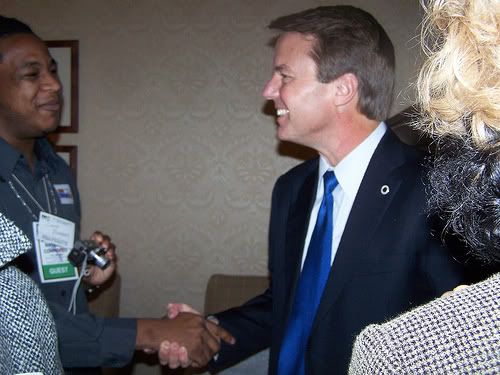
We only had to wait for a very few minutes after John's speech, and sure enough, he came in and shook hands with as many people as he could reach. Everyone cheered a lot when he came in and while he was there. I think it helped make everything a bit better for all the people in the room. I got a beautiful big smile, a handshake, and a "hi darlin'," which was nice.
He stood up on the platform and waved and thanked people for coming. He didn't stay too long, but Obama's speech was starting soon and I suspect he didn't want to be rude and talk over it. I was having problems with my camera, so my photos all turned out bad, but here's one I downloaded from the Edwards Flickr site (from that day, but not the overflow room).
Then Obama spoke, and by then he had gotten the message that people in the overflow room were pretty frustrated, so he gave a shout out to the overflow room. That was very well received, especially since most of the people in the room were Obama supporters. I was ready to leave after seeing John, but the Obama supporters there had been very nice during John's speech and when he came in the room, so Scott and I felt an obligation to be nice to their candidate.
Obama gave a good speech, but digging below the surface of sweet rhetoric, I didn't like some of the things Obama said in his speech. Honestly, he is far too conciliatory for me. (I could not find a transcript of his speech, but I always think he talks far too much about "bringing the country together" and bipartisanship.)
After the past 7 years, I want someone who will take the Republicans and the corporate interests on and fight them. I don't want someone who will try to make nice with them. Negotiations are a necessary part of politics, but you have to start from a position of strength, not a position of compromise.
You can't settle for less before you even get started negotiating because you think you won't get what you really want. Obama's health care plan, which is not universal and would leave up to 15 million people uncovered, is a great example of how NOT to achieve change.
I think this is the essential difference between the approaches to change that John Edwards and Barack Obama are taking. John is a fighter who will take them on. Obama seeks compromise, negotiation, and reconciliation, as evidenced both by his speech yesterday and by the "Carry" ad he's been running in New Hampshire and Iowa, which touts his bipartisanship.
Contrast that with this Edwards ad from Iowa:
Obama spoke in his speech about attracting Republicans and independents. I want to draw a distinction here between a candidate who entices Republicans and independents because he seeks compromise with them (Obama) and a candidate who appeals to Republicans and independents because he takes a strong stand and offers a bold vision and leadership on problems that affect them too (Edwards). After the recent Republican debate, one of the undecided Republicans in CNN's focus group said she would support Edwards (the most progressive major Democratic candidate) because at least Edwards has ideas.
I know which one I want in the oval office and which one I think will work, and that is John Edwards's more confrontational approach. It's called backbone, and we Democrats have been looking for it for a long time.
I think Obama may very well be a nice guy with good intentions. That isn't the point. What we need now is a fighter. We need someone who has taken on corporate interests and won consistently, and that's John Edwards.
The Obama supporters in the room, however, were really enthused by the end of his speech. One woman, obviously thinking I was far more impressed than I actually was, because of my polite cheering, I guess, asked me if I was thinking about switching. I told her absolutely not.
Obama made his supporters wait quite a long time, but when he did come in, he got mobbed. Scott managed to reach over a lot of people and shake Obama's hand, but I was keeping a bit of distance between myself and the thick of the crowd. I have been in one or two intense crowd situations and crowds can freak me out a bit if I feel it will become difficult to move.
Obama gave a short pep talk and then left, and I think most of his supporters followed him, because the room cleared out quickly.
Scott and I stayed and chatted for a long time with a very nice woman next to him, who I had assumed was an Obama supporter, but it turned out she was undecided. She was concerned about electability, so I talked to her about the fact that John seems to be the most electable Democrat based on head to head matchup polls, and also about some of the reasons why I like Edwards more than Obama.
Since all the Obama supporters had followed their candidate, I didn't have anyone trying to argue with me while I pointed out the flaws in Obama's health care plan (the major one is it's not universal) and pointed out why John would be so much more aggressive in pursuing a progressive agenda (because, as I said above, you can't start from a position of compromise). I also told her about his 80 page booklet on policy and where she could download it. She was definitely listening, so that was a good score! I don't know for sure that she will end up supporting him, but she was very receptive.
After we were ushered out of the room by hotel staff trying to clean during the break between sessions, we saw Kate Michelman near the Edwards table, and I blurted out "Kate Michelman! Hi!" She looked like she recognized me, which she probably did since I've been in a small group where she spoke before, and she greeted me like she knew me, but it occurred to me later that she probably had no real idea who I was. Anyway, she was very nice.
After that, Scott and I were both just about weak with hunger, so we found the nearest tolerable restaurant, which turned out to be Panera Bread. Guess who we ran into there? My friend from the campaign staff! He came right up to me and gave me a hug, and we chatted for a little bit. Really nice guy. He was really very appreciative of the fact that he always sees me at Edwards events.
Anyway, so then we drove home through a lot of traffic, only finding out about the Hillary campaign hostage situation when we got to Scott's house. Like I said, strange day.
It was nice of Edwards and Obama to both come in and greet the people in the overflow room, though, so that made up for the other weirdness of the day quite a bit. Both men seem like nice people. I just prefer John's strong confrontational approach. We need someone to stand up for us. We need someone to help us tear down the wall. We need a fighter.
UPDATED: The Peru FTA's Expanded Giant Sucking Sound Just Got Louder
In a few moments, I will sign three agreements that will complete our negotiations with Mexico and Canada to create a North American Free Trade Agreement. In the coming months, I will submit this pact to Congress for approval. It will be a hard fight, and I expect to be there with all of you every step of the way. We will make our case as hard and as well as we can. And though the fight will be difficult, I deeply believe we will win. And I'd like to tell you why: first of all, because NAFTA means jobs American jobs, and good-paying American jobs. If I didn't believe that, I wouldn't support this agreement.
Well, that didn't work out so well for us, did it? In fact, third party presidential candidate Ross Perot was more accurate when he described NAFTA as a "giant sucking sound." So what's up with the Peru Free Trade Agreement currently being pushed through Congress? Is it more of the same?
"Unlike NAFTA and CAFTA, the Peru Trade Agreement includes real, enforceable labor and environmental protections," Obama spokesman Jen Psaki said.
"Speaker Pelosi and Congressmen Rangel and Levin deserve credit for fighting hard for these provisions, and Barack Obama supports their efforts to make sure that our trade policies help American workers, not just big corporations," Psaki said.
Sound familiar? You might even say it...
means jobs American jobs, and good-paying American jobs. If I didn't believe that, I wouldn't support this agreement.
(Bill Clinton on NAFTA again.)
I've got three words for this expansion of NAFTA: Growing Sucking Sound.
So what has Hillary Clinton, the spouse of the man who gave us NAFTA, said on this new free trade agreement? Crickets.
"For decades, our leaders in Washington have pursued trade policies that have devastated communities like the ones I grew up in. Take NAFTA - it was supported by insiders from both political parties, but it has cost us more than 1 million jobs. Now, at a time when American families are terribly concerned about job losses and a weak economy, our Congress is about to vote on expanding the NAFTA-free trade model to Peru.
"The Peru deal will continue the trade policies that have long failed our workers and cost American workers their jobs. It's time to show some guts and backbone, stand up and oppose this trade deal, and demand trade policies that put families and workers first. I urge members of Congress to vote against this deal today.
"The fact that the Peru trade deal is supported by a bipartisan group of insiders, including George Bush and senior officials from the first Clinton Administration - many of whom are now lobbyists, corporate lawyers, and business consultants - should be proof-positive of why members of Congress should join with me and oppose this deal. The benefit to corporate lobbyists from both sides of the political aisle will come only at the expense of hard-working families.
"Senator Obama has chosen to support this bad deal. I strongly disagree with his position, but at least he has taken one. Senator Clinton, on the other hand, has refused to take any position. I urge Senator Clinton to publicly announce, today, her opposition and join with me in encouraging members of Congress to vote against the Peru trade deal."
Edwards is Right, Obama's Wrong, Clinton's Useless
As Illinois Congressman Phil Hare, a former textile union leader who has led the fight against the Bush-Pelosi line, notes: Peru is currently threatening striking miners with the loss of their jobs if they do not return to the mines. That's not protecting the rights of workers. Indeed, says Hare, "The striking miners were fighting for, among other things, an eight hour work day. In addition, we recently learned that there are 2 million children working in Peru, many in these very same mines."
"Is this the progress the supporters of the Peru FTA were referring to?" asks Hare, who adds, "Today's news should serve as yet another wakeup call that the best thing to do for workers both at home and in Peru is defeat this unfair trade deal."
Hare's right. But he needs some allies among the party's leading presidential contenders.
Obama's wrong and Clinton's of no use.
Thankfully, John Edwards is reading the issue right.
"The Democratic leadership, I'm surprised at,"Bruce Raynor, president of UNITE Here, a textile and service employees union, told reporters on a conference call opposing the Peru bill this week. "I think they failed to remember that in the last election many Democrats were elected to the House and Senate on the issue of failed trade policy."
TheMiddleClass.org from the Drum Major Institute has this to say about this bill:
The Middle Class Opposes. Increased international trade can contribute to economic growth, but the way trade rules are formulated in agreements like this means that the benefits of trade are distributed unevenly, ultimately undermining the middle class and aspiring middle class in both the U.S. and the nations it trades with. A central problem is that the Peru trade agreement empowers businesses and investment capital to cross international borders more easily, providing a decisive advantage over working people who are not so internationally mobile and whose rights are not equally well protected in all of the nations covered by the agreement. This imbalance of power creates incentives to move U.S. jobs overseas and puts downward pressure on the wages of American workers as they are placed in more direct competition with poorly-paid, disempowered Peruvian workers.
I'm glad to see that my presidential candidate, John Edwards, is once again taking the right position and leading on an issue where the other major Democratic presidential candidates are either taking the wrong position, or failing to lead. Edwards has been outspoken and clear on his position on this and just about every other issue. This reminds me of a quote from Harry Truman:
There is not a single, solitary man or woman in the United States today who can't find out in two minutes where I stand on the important matters like foreign policy, labor, agriculture, social security, housing, high prices, and all the other problems we as a nation have to face.
But there is not a single, solitary man or woman in the United States who has been able, within the last 2 months, to find out where the Republican candidate stands on these issues.
... except that where Harry Truman was talking about Republicans, we are now having a problem finding out where some of the Democratic candidates stand.
Subject: House of Representatives Passage of the Peru Trade Promotion Agreement
House of Representatives Passage of the Peru Trade Promotion Agreement
Statement by Secretary Condoleezza Rice
House of Representatives Passage of the Peru Trade Promotion Agreement
Washington, DC
November 8, 2007
I am very pleased by the House of Representatives' strong bipartisan approval of the Peru Trade Promotion Agreement. The Peru Trade Promotion Agreement's mutual benefits are clear. It benefits U.S. workers and farmers by giving our products the same treatment in Peru that Peru's exports enjoy in the United States. It helps Peru alleviate poverty by creating jobs and economic opportunities, sharing with the people of Peru the benefits of their democracy and open markets. Through the benefits of two-way trade, this agreement will reinforce the foundation of our deep and strong
relationship. The House of Representatives' strong vote for this agreement demonstrates that the United States remains an active and committed partner in the hemisphere.
I look forward to a Senate vote in the near future, and urge Congress to approve the pending trade agreements with Colombia, Panama and South Korea.
EDWARDS STATEMENT ON HOUSE PASSAGE OF PERU TRADE DEAL
Chapel Hill, North Carolina - Today, Senator John Edwards released the following statement:
"I'm disappointed by today's vote to approve the Peru trade deal and expand the failed NAFTA model that has cost us more than a million jobs. However, I congratulate the 132 members - including a majority of the voting House Democrats - for their courage in standing up and voting against this flawed deal. The vote should be an alarm bell for President Bush: other flawed trade deals, including South Korea and Columbia, need to be improved before they are brought before Congress.
"I believe that American workers and businesses can compete with any worker or company in the world as long as our government stands up and fights for a level playing field. American workers deserve trade agreements that strengthen and maintain, rather than undercut and erode, labor rights, environmental standards and wages.
"While I believe Senator Obama is wrong to give this president authority to risk American jobs with more bad trade deals, at least he has taken a position. Unfortunately, Senator Clinton has still refused to take a position on this proposal. I believe voters deserve to hear the truth and I urge Senator Clinton to join me in calling on members of the Senate to reject the Peru trade deal in the coming weeks."
UPDATE III:
EDWARDS STATEMENT ON SENATOR CLINTON’S SUPPORT FOR THE PERU TRADE DEAL
Chapel Hill, North Carolina – Today, Senator John Edwards released the following statement expressing his disappointment in Senator Clinton’s support for the Peru trade deal:
“I am terribly disappointed by Senator Clinton’s support for the Peru trade deal. At a time when millions of Americans are concerned about losing their jobs and the economy, it is dismaying that Senator Clinton would side with corporations, their lobbyists and the Bush Administration in support of a flawed trade deal that expands the NAFTA model.
“As I have said before, there are real and serious differences in this presidential race, and our stands on this trade deal are another example. Whereas voters in Iowa, New Hampshire and all across America have learned that I will fight for safe and smart trade, now they see that Senator Clinton, by supporting this trade deal, has chosen to follow a very different path.
“It’s time for Senator Clinton to stand up for working Americans and stop defending corporate lobbyists and a broken system in Washington.”
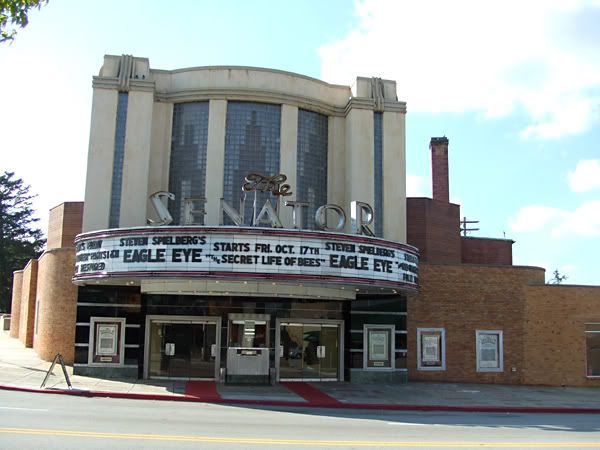


 Health care is a human right. In my own definition of the progressive movement, I count that as a basic progressive principle.