Observing from beyond the solar system, a cultural outsider looks in.

Tuesday, April 01, 2008

Tibetans to Bush: Don't Go to Beijing Olympics -- Rally in DC -- UPDATED

Please see the update at the end of this diary, with letters to the Chinese people and the world from His Holiness the Dalai Lama.
Yesterday, a large group of Tibetans, Americans of Tibetan ancestry, and other American supporters gathered at Lafayette Park outside the White House in Washington, DC to ask President Bush to make a statement for human rights and refused to attend the opening ceremonies of the Beijing Olympics in protest of Chinese government oppression of Tibet.

I have been very moved by the mostly nonviolent struggle of the Tibetans to regain their freedom, and by the strength and compassion shown by the Dalai Lama in urging them to maintain nonviolence at all times. I decided it was important to go and stand in solidarity with them. This is my report on the event.
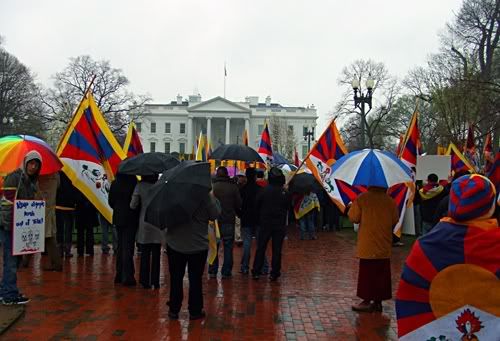


The plan for the day was to meet at Lafayette Park, hear some speakers, and then march up Connecticut Avenue to the Chinese Embassy, which is just before the bridge that goes over Rock Creek Park. If you're not familiar with DC, I can tell you this is a fairly long walk. I didn't take any notes, but I did take a lot of pictures and a few videos, so this will be a very visual report.
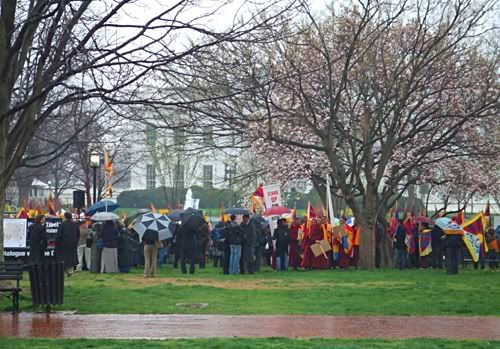


When I first arrived at Lafayette Park, the event really hadn't started, but people were standing facing the White House and chanting slogans like "Free Tibet Now," "China is a liar," and "Long live the Dalai Lama!"

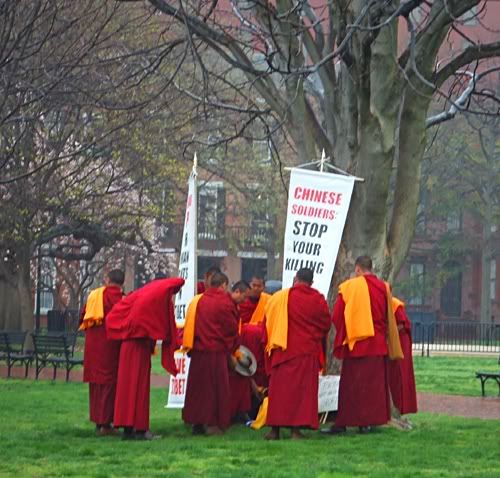
As I approached the gathering, a small cluster of Tibetan monks stood together and apart from the crowd with their banners. Maybe they were praying, or maybe they were just planning their involvement in the event. I was happy to see them. Buddhist monks always seem to have such a nice calm energy. I am slightly mystified by why I like them so much. Perhaps it's because they preach compassion and seem to do an admirable job of practicing it too. I just know that I feel like my heart opens just a little bit more every time I see Tibetan monks. I was saddened to see the messages on the banners they carried.


I stood with the rest of the crowd and chanted the slogans with them as best I could. Sometimes I had a little bit of trouble understanding what they were saying, either because the person leading the chant was shouting a little too loudly for his voice, or because of the accents and the general confusion of crowd noise. I wasn't there too long before the crowd started a mass movement in one direction, so I followed them, and we gathered around a stage that I hadn't noticed before.
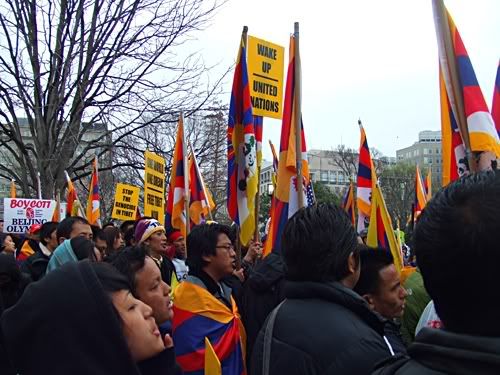


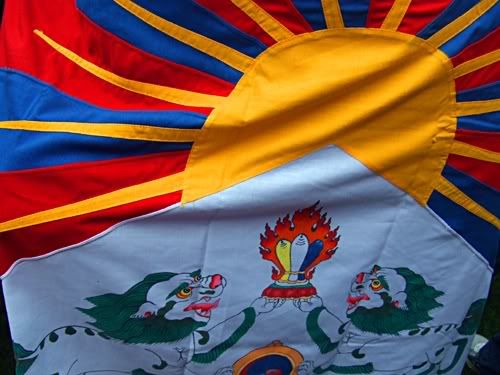
The crowd around me was very colorful, or perhaps I should say very united in their color choices. Many of them carried or wore the flag of Tibet, often draped around their shoulders like a cape.


The first speaker described the current situation in Tibet, in which the exiled Tibetan government says there have been at least 140 people killed. The Tibetan government has released the names of 40 of them, and many people in the crowd held signs with these names on them.


Several other speakers followed, many of them from various Tibetan organizations in the United States. There was also a speaker from Amnesty International. U.S. Representatives Abercrombie of Hawaii and Kucinich of Ohio also spoke.
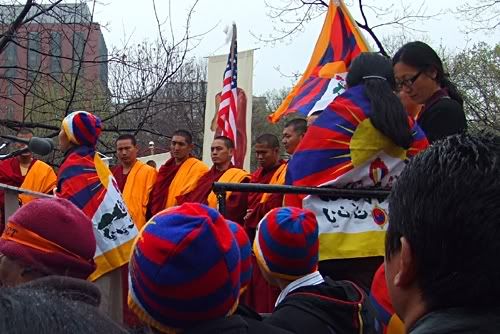


Representative Abercrombie had been to Dharamsala, India with the congressional delegation led by Nancy Pelosi to meet with the Dalai Lama. Representative Kucinich had also met with the Dalai Lama when he was in the United States to receive the Congressional Medal of Honor, and he spoke about that meeting and also the great opportunity for the world and for China to learn nonviolence and compassion from the Tibetan people.


I have to apologize for the quality of my videos. I was standing on the side of the stage, and often could not see the speakers. Anyway, here is at least a partial picture of Dennis as he left the stage.
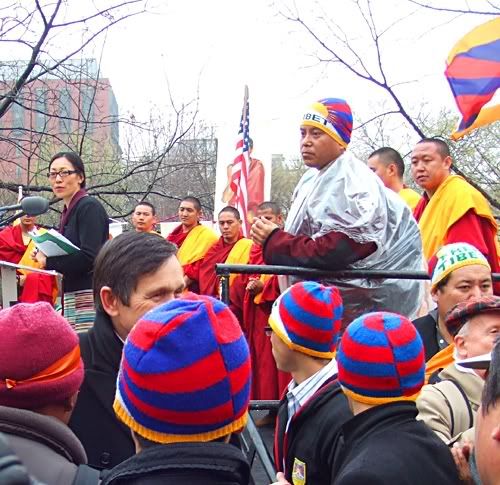


A few times the speakers spoke in Tibetan, and there was some singing in Tibetan, including what I think they called the Tibetan National Uprising Song. There is a portion of the end of that in the first video.

Although I didn't understand everything that was said, it is very clear that a harsh injustice is being done to these people and their friends and families in Tibet. Several times the speakers brought me to tears.

Some of the speakers mentioned the missing Panchen Lama, who disappeared when he was just a young boy and is believed to be a political prisoner in China.
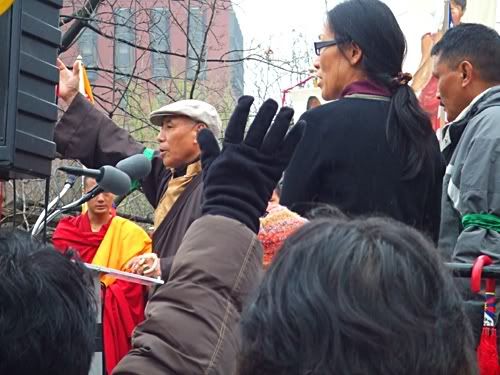


There is also a serious environmental concern here, because China is doing a lot of mining in Tibet and is dumping nuclear waste in Tibet, according to some of the speakers at the event. If you saw Al Gore's An Inconvenient Truth, then you may remember that 40% of the world's water comes from the Himalayas. What China is doing in Tibet is polluting the water at the source for many people that live downstream.
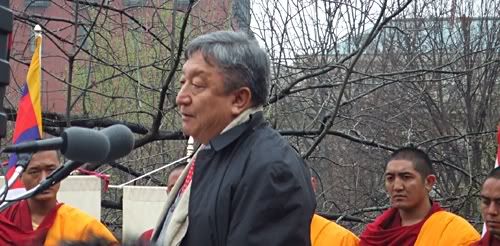


One of the speakers was an emissary from the Dalai Lama, who reminded the crowd that Tibet has the world's sympathy because of their nonviolent approach, and urge them to have patience and maintain nonviolence at all times. He also spoke about encouraging signs in Europe and the United States that the world may be ready to help Tibet. I didn't catch the man's name, but the Washington Post says he was Lodi Gyaltsen Gyari.


After the speeches were over, people began to line up for the march up Connecticut Avenue to the Chinese Embassy. The monks led the way.
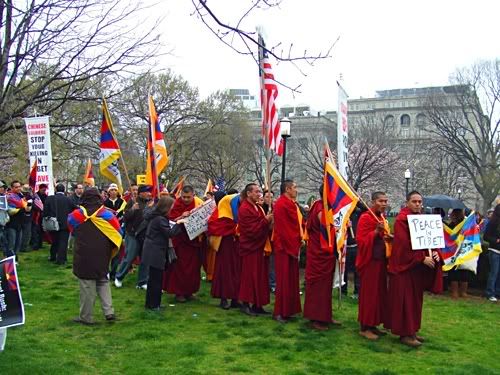
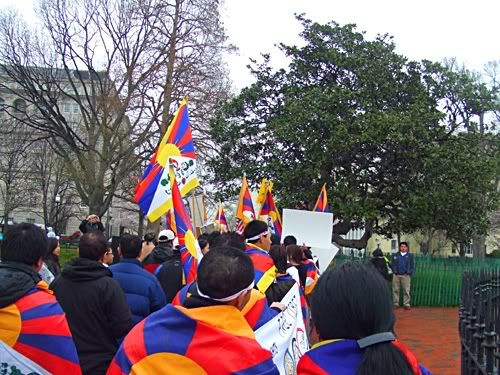


There was more chanting of slogans as we walked in our long procession. Many people driving by honked at us in support. Some people carried banners that bore photos of recent Chinese atrocities.
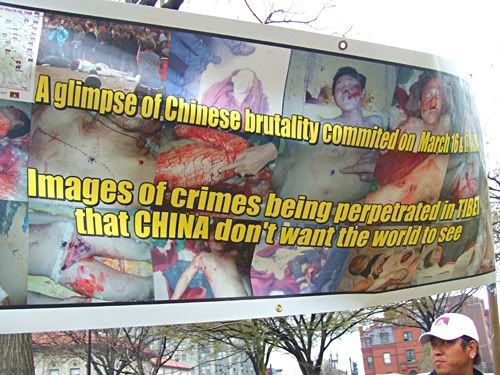
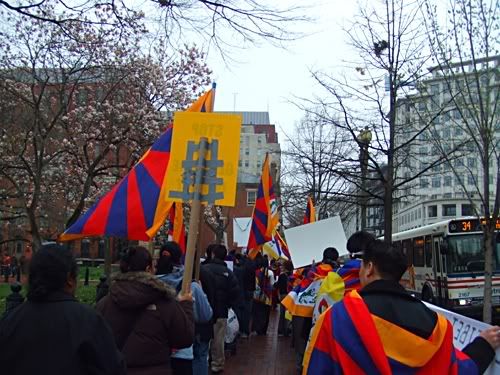


We stopped for a rest when we got to Dupont Circle, probably partly because it was a very visible location for people driving by, but also because it was time for lunch. This may be the only big protest I've ever been to where the organizers fed everyone. How cool is that? They really took care of us. It was only bread, granola bars, water, and a bit of chocolate, but people need something when they are marching for that long, and it was kind of the event organizers to think of that.
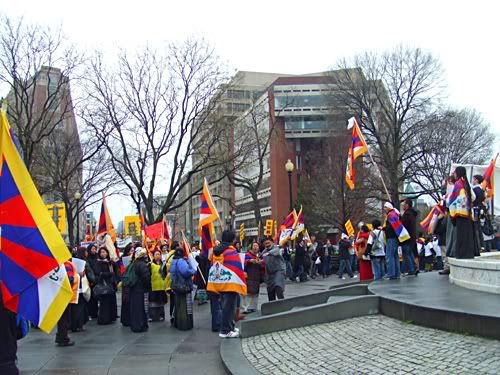
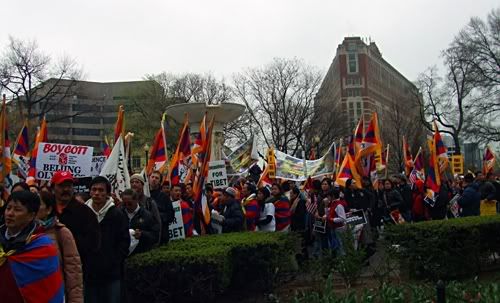


Soon it was time to continue toward the Chinese Embassy.
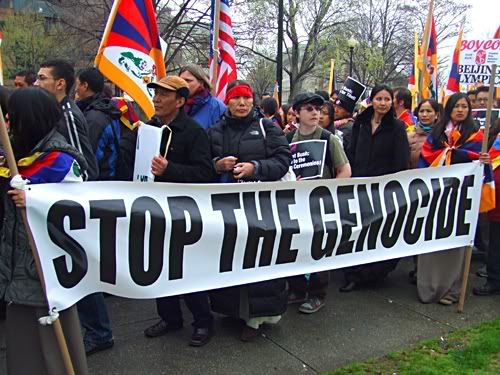


We arrived at the embassy and gathered on to a little patch of garden in front of it. The big colorful crowd continued to chant slogans as a few people watched us from the embassy windows, and passing cars honked in support.
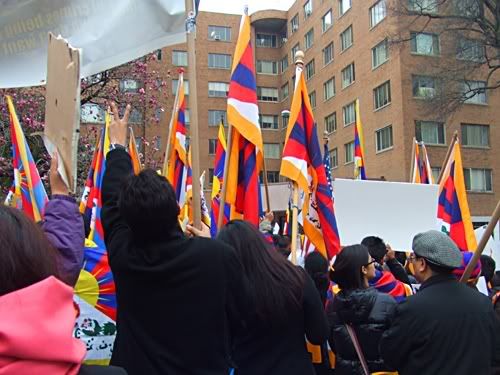
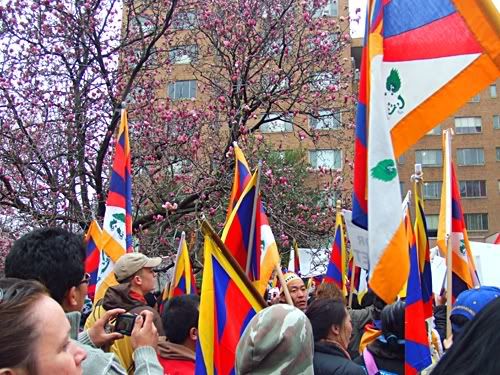
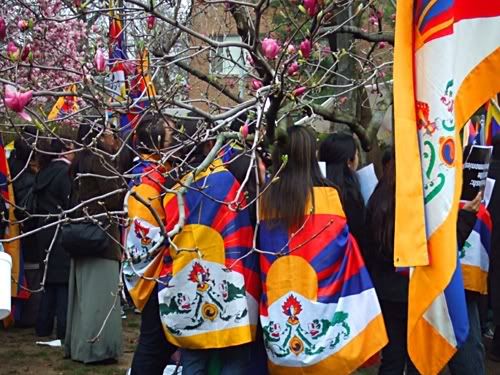
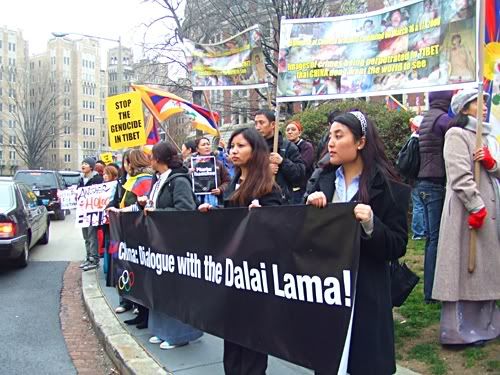
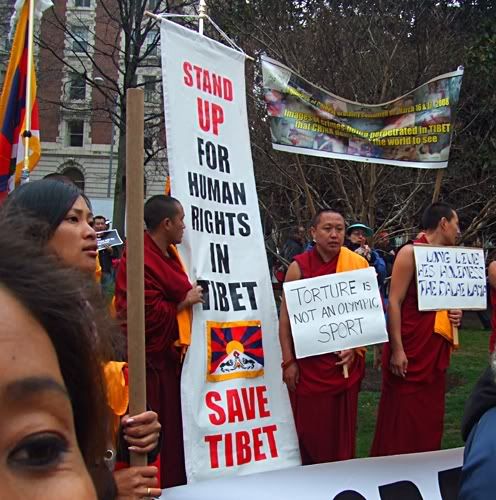
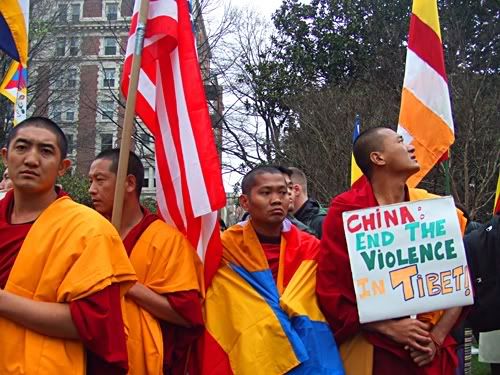
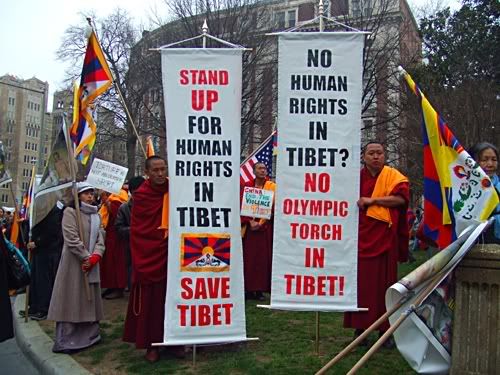


As the monk's banner in that last photo points out, there is an issue about the Olympic torch going through Tibet. Right now, China plans to have the Olympic torch go through Tibet, which is a slap in the face of the Tibetan people while they are living under oppression. The Olympics are supposed to be a symbol of international cooperation and friendship. To have it run through Tibet while Tibet is being brutally oppressed by a foreign dictatorship is not in the Olympic spirit, and it is an insult to the Tibetan people because it ignores the fact that they are not free.

Please help by signing this petition to keep the Olympic torch out of Tibet.

UPDATE:

The Dalai Lama has issued letters to the Chinese people all over the world, and to the world and its leaders.

The letter to the Chinese people express is the Dalai Lama's willingness for Tibet to remain part of China, as long as the grievances of the Tibetan people can be addressed. It shows great compassion to the Chinese people.

Today, I extend heartfelt greetings to my Chinese brothers and sisters around the world, particularly to those in the People’s Republic of China. In the light of the recent developments in Tibet, I would like to share with you my thoughts concerning relations between the Tibetan and Chinese peoples, and make a personal appeal to all of you.

I am deeply saddened by the loss of life in the recent tragic events in Tibet. I am aware that some Chinese have also died. I feel for the victims and their families and pray for them. The recent unrest has clearly demonstrated the gravity of the situation in Tibet and the urgent need to seek a peaceful and mutually beneficial solution through dialogue. Even at this juncture I have expressed my willingness to the Chinese authorities to work together to bring about peace and stability.

Chinese brothers and sisters, I assure you I have no desire to seek Tibet’s separation. Nor do I have any wish to drive a wedge between the Tibetan and Chinese peoples. On the contrary my commitment has always been to find a genuine solution to the problem of Tibet that ensures the long-term interests of both Chinese and Tibetans. My primary concern, as I have repeated time and again, is to ensure the survival of the Tibetan people’s distinctive culture, language and identity. As a simple monk who strives to live his daily life according to Buddhist precepts, I assure you of the sincerity of my personal motivation.

I have appealed to the leadership of the PRC to clearly understand my position and work to resolve these problems by “seeking truth from facts.” I urge the Chinese leadership to exercise wisdom and to initiate a meaningful dialogue with the Tibetan people. I also appeal to them to make sincere efforts to contribute to the stability and harmony of the PRC and avoid creating rifts between the nationalities. The state media’s portrayal of the recent events in Tibet, using deceit and distorted images, could sow the seeds of racial tension with unpredictable long-term consequences. This is of grave concern to me. Similarly, despite my repeated support for the Beijing Olympics, the Chinese authorities, with the intention of creating a rift between the Chinese people and myself, the Chinese authorities assert that I am trying to sabotage the games. I am encouraged, however, that several Chinese intellectuals and scholars have also expressed their strong concern about the Chinese leadership’s actions and the potential for adverse long-term consequences, particularly on relations among different nationalities.


This is a very long letter, but it is worth reading in full.

The letter to the world explains what the Dalai Lama is asking of each of us and our leaders.

I therefore appeal for your continued support in calling for an immediate end to the current crackdown, the release of all those who have been arrested and detained, and the provision of proper medical treatment. We are particularly concerned about the provision of adequate medical facilities, as there are reports of many injured Tibetans being afraid to go to Chinese-run hospitals and clinics.

I would also request you to encourage the sending of an independent international body, to investigate the unrest and its underlying causes, as well as allow the media and international medical teams to visit the affected areas. Their presence will not only instill a sense of reassurance in the Tibetan people, but will also exercise a restraining influence on the Chinese authorities.


I continue to be inspired by this great man and hope that his kindness and compassion can be an inspiration to the world to solve this problem and create new bonds of friendship. As he says to the Chinese:

However, instead of cultivating enmity towards the Chinese leaders responsible for the ruthless suppression of the Tibetan people, I prayed for them to become friends, which I expressed in the following lines in a prayer I composed in 1960, a year after I arrived in India: “May they attain the wisdom eye discerning right and wrong, And may they abide in the glory of friendship and love.”

Labels: , , , , , , , , , , , , , ,

Sunday, December 02, 2007

I saw John Edwards and Barack Obama at the DNC Fall Meeting: an adventure

On Friday, I went to the DNC Fall Meeting with a friend of mine to see John Edwards. It was an adventurous, though not altogether pleasant, kind of day. Here's my story of a trip to a political event that was unexpectedly eventful. I'll also discuss John Edwards' and Barack Obama's very different approaches to change.

The event on Friday was supposed to be in Baltimore, which would have been convenient for me, but the workers at the original hotel location were on strike, so the DNC moved the location three weeks ago. I say kudos to the DNC for respecting the picket line, and I hope last minute planning helps explain some of the chaos at the event.

My friend Scott and I got up super early to drive to Tysons' Corner, VA, outside DC for the event. Neither of us are morning people. Such dedication!

When we arrived, there were already quite a few people waiting outside, but we were immediately greeted by friendly Edwards staffers. Unfortunately, we had to wait in line for hours; about half of that time was spent standing outside in the cold.

We were told the ballroom access would be first come first serve, and there was only room for maybe 150 supporters (in addition to the DNC members who had a guaranteed seat). There were a whole lot more than 150 guests of the various campaigns there. I kind of think each of the major campaigns had that many of their own supporters there, actually.

The event seemed disorganized. All the major campaigns had a lot of supporters there, including a lot of people from the mine workers union for Edwards. It seemed like the campaigns must have been told they could bring a lot more guests than would actually fit in the room. This could have been because of the change of venue, I guess.

I had heard that they were going to let in about 150 people, but unless they were getting them from somewhere else other than the line we knew about, I don't think they did. I think we would have been in there if they had. Most of the Edwards supporters that were there early, as well as certainly any that came at all late, like some other friends of mine did, were not let into the event. They pretty much cut off the number of people they were letting into the ballroom when they got to the mine workers for Edwards, who were standing a few feet in front of me and my friend.

They let the next couple hundred people into an overflow room, where there was a TV. Some of the Edwards supporters ahead of us, many of them mine workers, had been taken out of the line by one of the Edwards staffers to go and shake hands with John when he arrived. We didn't really know that was what was happening until later, or I would have tried to follow them. So they were no longer with us, and we ended up in a room with mostly Obama supporters and a few Edwards supporters.

There were a lot of Edwards supporters in total at the event, but a few were let into the ballroom, judging by what I saw later on C-Span, a big group got out of line to go shake hands with John (but they were told they could not get into the overflow room if they got out of line), and then another fairly big group were let into the overflow room, so we were all split up. Anyway, our numbers were a lot bigger than they looked on TV.

There was a big TV in the overflow room, so we were not happy that we had driven all that way and stood in line all that time to watch something on TV that we could have seen on C-SPAN.

Then it gets worse.

Howard Dean spoke at the beginning, briefly. Then someone came up to introduce Richardson, and then the sound for the video system cut out. Richardson was talking, but we weren't hearing a thing! There was nearly a riot in the overflow room. I am not kidding you. It was ugly. People were chanting "fix the sound! Fix the sound!" Any of the hotel staff that came in the room to try to do that were getting yelled at by some people. We missed all of Richardson's speech.

When John's speech started and the sound was still not fixed, what was already verging on a riot kicked into a higher gear. Keep in mind everyone had been made to wait for hours, much of it outside in the cold, for something we could have watched at home on C-Span already, and now we couldn't even hear it. Some people walked out, but we stayed, hoping they'd get the sound fixed.

I kept thinking that if John Edwards knew what was going on in there, he would definitely come in after his speech and say hello to people. I had no way of knowing if he knew that, though.

Eventually, one of the Obama supporters sitting near me stood up and told people that she had just asked one of the DNC people very nicely to please try to send the candidates in after their speeches, because a lot of people had come to see them and waited a long time. That was when it dawned on me that I knew some of the Edwards staffers and there was no harm in at least asking a favor.

I went out in search of a friend on the Edwards staff and found him by the Edwards table. (To clarify, I do not work for Edwards. I'm just an enthusiastic volunteer.) I took my friend's hand and said something like "there are a lot of people in the overflow room, some of whom came just to see John, and now we can't hear his speech, and everyone in there is pretty upset right now. Is there any way that John can come in and at least say hi to people after his speech?" My friend sent a text message to someone, and he and the other man at the table told me that if it could happen, it would. I thanked them and went back in the room.

By then, they had fixed the sound at least enough to hear what John was saying, though the quality wasn't great. We heard maybe about the second half of John's speech, which was excellent, although I had to wait until I got home to watch the whole thing, in the video below.


Here's just a short excerpt from his speech that gives a small taste of his passion for this fight for change:

This is bigger than politics. Bigger than any candidate or political party. Because the truth is that it's not just Republicans who built this wall. Democrats helped too. Too many politicians from both parties are choosing self-preservation over principle, compromise over convictions.

"You have a choice in this election. You have to decide what kind of person you want as your next president. Do you want someone who is going to pretend that wall around Washington isn't there, or defend the people who helped build it? Or do you want someone who is going to lead with conviction and tell you the truth, and have a little backbone? Do you want someone who is going to hope that the people who spent millions of dollars and decades building that wall, and have billions more invested in keeping it up, are going to be willing to compromise, to take it down voluntarily? Or do you want someone who is going to stand up to those people and fight for your interests, when the chips are down, when your backs are against the wall, every single day?

"We have a choice in this election. We can keep trying to shout over that wall. We can keep trying to knock out a chink here and there, to punch little holes in it and hope our voices get through. We can settle for baby steps, half-measures and incremental change, and try to inch our way over that wall and toward a better future. Or we can be bold and knock it down.


The speech was all about tearing down the wall around Washington, and it seemed like we were at that moment experiencing another facet of that metaphor, by being kept out in a separate room where we couldn't even hear what was going on at first. His speech was met with enthusiastic cheers by most everyone, including the Obama supporters.

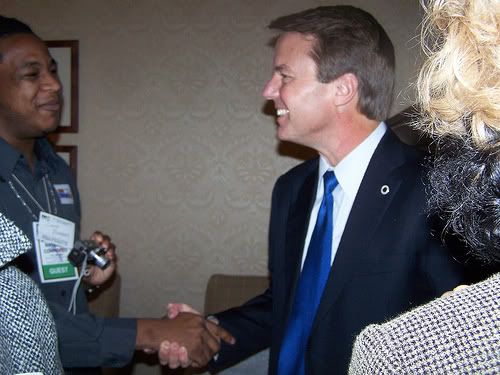
We only had to wait for a very few minutes after John's speech, and sure enough, he came in and shook hands with as many people as he could reach. Everyone cheered a lot when he came in and while he was there. I think it helped make everything a bit better for all the people in the room. I got a beautiful big smile, a handshake, and a "hi darlin'," which was nice.

He stood up on the platform and waved and thanked people for coming. He didn't stay too long, but Obama's speech was starting soon and I suspect he didn't want to be rude and talk over it. I was having problems with my camera, so my photos all turned out bad, but here's one I downloaded from the Edwards Flickr site (from that day, but not the overflow room).


Then Obama spoke, and by then he had gotten the message that people in the overflow room were pretty frustrated, so he gave a shout out to the overflow room. That was very well received, especially since most of the people in the room were Obama supporters. I was ready to leave after seeing John, but the Obama supporters there had been very nice during John's speech and when he came in the room, so Scott and I felt an obligation to be nice to their candidate.

Obama gave a good speech, but digging below the surface of sweet rhetoric, I didn't like some of the things Obama said in his speech. Honestly, he is far too conciliatory for me. (I could not find a transcript of his speech, but I always think he talks far too much about "bringing the country together" and bipartisanship.)

After the past 7 years, I want someone who will take the Republicans and the corporate interests on and fight them. I don't want someone who will try to make nice with them. Negotiations are a necessary part of politics, but you have to start from a position of strength, not a position of compromise.

You can't settle for less before you even get started negotiating because you think you won't get what you really want. Obama's health care plan, which is not universal and would leave up to 15 million people uncovered, is a great example of how NOT to achieve change.

I think this is the essential difference between the approaches to change that John Edwards and Barack Obama are taking. John is a fighter who will take them on. Obama seeks compromise, negotiation, and reconciliation, as evidenced both by his speech yesterday and by the "Carry" ad he's been running in New Hampshire and Iowa, which touts his bipartisanship.


Contrast that with this Edwards ad from Iowa:


Obama spoke in his speech about attracting Republicans and independents. I want to draw a distinction here between a candidate who entices Republicans and independents because he seeks compromise with them (Obama) and a candidate who appeals to Republicans and independents because he takes a strong stand and offers a bold vision and leadership on problems that affect them too (Edwards). After the recent Republican debate, one of the undecided Republicans in CNN's focus group said she would support Edwards (the most progressive major Democratic candidate) because at least Edwards has ideas.


I know which one I want in the oval office and which one I think will work, and that is John Edwards's more confrontational approach. It's called backbone, and we Democrats have been looking for it for a long time.

I think Obama may very well be a nice guy with good intentions. That isn't the point. What we need now is a fighter. We need someone who has taken on corporate interests and won consistently, and that's John Edwards.

The Obama supporters in the room, however, were really enthused by the end of his speech. One woman, obviously thinking I was far more impressed than I actually was, because of my polite cheering, I guess, asked me if I was thinking about switching. I told her absolutely not.

Obama made his supporters wait quite a long time, but when he did come in, he got mobbed. Scott managed to reach over a lot of people and shake Obama's hand, but I was keeping a bit of distance between myself and the thick of the crowd. I have been in one or two intense crowd situations and crowds can freak me out a bit if I feel it will become difficult to move.

Obama gave a short pep talk and then left, and I think most of his supporters followed him, because the room cleared out quickly.

Scott and I stayed and chatted for a long time with a very nice woman next to him, who I had assumed was an Obama supporter, but it turned out she was undecided. She was concerned about electability, so I talked to her about the fact that John seems to be the most electable Democrat based on head to head matchup polls, and also about some of the reasons why I like Edwards more than Obama.

Since all the Obama supporters had followed their candidate, I didn't have anyone trying to argue with me while I pointed out the flaws in Obama's health care plan (the major one is it's not universal) and pointed out why John would be so much more aggressive in pursuing a progressive agenda (because, as I said above, you can't start from a position of compromise). I also told her about his 80 page booklet on policy and where she could download it. She was definitely listening, so that was a good score! I don't know for sure that she will end up supporting him, but she was very receptive.

After we were ushered out of the room by hotel staff trying to clean during the break between sessions, we saw Kate Michelman near the Edwards table, and I blurted out "Kate Michelman! Hi!" She looked like she recognized me, which she probably did since I've been in a small group where she spoke before, and she greeted me like she knew me, but it occurred to me later that she probably had no real idea who I was. Anyway, she was very nice.

After that, Scott and I were both just about weak with hunger, so we found the nearest tolerable restaurant, which turned out to be Panera Bread. Guess who we ran into there? My friend from the campaign staff! He came right up to me and gave me a hug, and we chatted for a little bit. Really nice guy. He was really very appreciative of the fact that he always sees me at Edwards events.

Anyway, so then we drove home through a lot of traffic, only finding out about the Hillary campaign hostage situation when we got to Scott's house. Like I said, strange day.

It was nice of Edwards and Obama to both come in and greet the people in the overflow room, though, so that made up for the other weirdness of the day quite a bit. Both men seem like nice people. I just prefer John's strong confrontational approach. We need someone to stand up for us. We need someone to help us tear down the wall. We need a fighter.

Labels: , , , , , , , , , ,

Friday, November 02, 2007

Stand Up for Better Media!

On Halloween, there was something scary happening in Washington, DC. The FCC was holding its final public hearing on localism and media consolidation, and they scheduled it only a week in advance, in the middle of the week, on a holiday. Clearly, they hoped nobody would show up.

Fortunately, thanks to the wonderful people at Free Press, there were hundreds of committed citizens there. I was one of them.

Citizens — some of whom had shown up at 4 a.m. to get in line for a chance to speak — crowded the sidewalk of the FCC for a Halloween-morning rally against media consolidation. Elected officials, civil rights and labor leaders, consumer and media reform advocates, activists and even a squad of cheerleaders all came out to urge the federal agency to stop any rule changes that could create more media consolidation.

Chairman Martin announced the Halloween hearing just a week beforehand and scheduled it during the day when most people couldn’t attend. This was just the most recent in a long line of barriers the FCC has thrown up to deter public involvement in media policymaking. In response, public interest and civil rights groups pulled together to organize a rally where the public’s voice couldn’t be ignored.

“We are gravely concerned that Chairman Martin would try to secretly move on such a critical issue with such a short timetable,” said Josh Silver, executive director of Free Press, which coordinates the StopBigMedia.com Coalition. “The public is being shut out of the process so that Martin can move forward with his Big Media giveaway.”


What's at stake here is that the FCC is threatening a move toward further loosening of restrictions on media ownership, so that the big media companies could buy up even more media outlets. They tried to do this in 2003, but there was strong public outcry against it, so it was blocked at that time. Now they're trying to do it again, and this time they hope it will slip under the radar.

Frustrating as it is to see Bush appointee Kevin Martin, the chairman of the FCC, trying to stifle public debate and give away our airwaves to big media, it was really inspiring to see the number and diversity of activists that showed up to oppose media consolidation. Almost everyone who spoke at the meeting, either on the panel of invited experts, or in the public comment period at the end, was saying that further media consolidation is a really bad idea.

I wish I had brought my camera and my notepad so that I could give a more detailed report on this, but like everyone else, I found out about the meeting rather belatedly, and it started early enough in the morning after the big Democratic debate on Tuesday that I didn't really plan anything out. It was all I could do to just show up. I was glad that many of the activists that were there came much more prepared than I was.

The panel contained a number of inspiring speakers, including Reverend Jesse Jackson Sr., Kim Gandy, president of NOW, Wade Henderson, president of the Leadership Conference on Civil Rights, and Andrew Jay Schwartzmann, president and CEO of Media Access Project. Citizen activists participating in the public comment period after the debate included Medea Benjamin and a group of women from Code Pink, owners of local media outlets, and the FCC cheerleading squad, which gave a hilarious satiric endorsement to media consolidation.

In addition to the hundreds of people that showed up on Tuesday, the FCC has received tens of thousands of letters against media consolidation from all over the country, including this one from presidential candidate John Edwards.

Kevin J. Martin

Chairman

Federal Communications Commission
445 12th Street SW
Washington, DC 20554

Dear Chairman Martin:

I urge you to cease your efforts to radically rewrite the rules preventing excessive media consolidation. You and your fellow commissioners have the responsibility to ensure that our nation's media is open, democratic and as diverse as the American people, and not – like too much of our economy and our political system today – dominated by the wealthiest Americans, large corporations and their lobbyists. Rewriting the ownership rules in the manner you propose is contrary to that responsibility.

For decades, administrations of both parties and the FCC have tolerated and even encouraged the extreme consolidation of our media. In just the two years after telecommunications deregulation in 1996, the ownership of nearly half of America's radio stations changed, and by 2000, one media company had acquired over 1,100 radio stations. Eight business conglomerates now control the majority of media content in America, and two-thirds of all independently-owned newspapers have shut down since 1975.

Any benefits to consumers from vertical integration have been overwhelmed by the threats to competition, fair pricing and journalistic independence. The result of all this over-concentration, Mr. Chairman, is a poorer democracy, with a few loud corporate voices drowning out independent perspectives and local participation.

High levels of media consolidation threaten free speech, they tilt the public dialogue towards corporate priorities and away from local concerns, and they make it increasingly difficult for women and people of color to own meaningful stakes in our nation's media. Rather than further weakening efforts to ensure a diverse media, as you now propose, the FCC should instead be strengthening media ownership and concentration limits so that a few huge multinational corporations are not in charge of shaping our democracy.

When your predecessor Chairman Powell made a similar attempt, nearly 3 million highly diverse Americans wrote to the FCC to express their grave concerns. I hope that you and your fellow commissioners can find the will to continue to deny the ambitions of a small number of media executives and their lobbyists, in the interest of advancing a fuller, fairer democracy.

Yours sincerely,

John Edwards

Cc: Commissioner Jonathan S. Adelstein
Commissioner Michael J. Copps
Commissioner Robert M. McDowell
Commissioner Deborah Taylor Tate


The public pressure does seem to be mounting, and hopefully there will be enough of it before it's too late.

If you have access to television (unlike me), don't miss Bill Moyers Journal tonight! The show will look at the FCC's rush toward media consolidation and what that means for local and minority owned media.

"The FCC has a sad history when it comes to its treatment of women and minorities in broadcasting," remarked FCC Commissioner Jonathan Adelstein at a recent media symposium in Chicago. Adelstein concludes:
"We need to implement policies that will address this crisis before we act on any rules to further consolidate the media, which can only take media outlets further out of the reach of women and people of color."

Still, as reported in THE NEW YORK TIMES, FCC Chairman Kevin J. Martin seems determined to push though relaxations on media-ownership rules that currently prevent the same company from owning both a newspaper and a television or radio station in the same city. "I think it is an appropriate time to begin a discussion to complete this rule-making and complete these media ownership issues," Chairman Martin told THE TIMES.


There's a bit of encouraging news here. The Senate Commerce Committee will hold a hearing on the issue of localism and media consolidation on November 8th.

While this was the last of the FCC’s localism hearings, it won’t be the last of localism. The day after the rally and hearing, the Senate Commerce Committee announced that they were holding a hearing on localism and media ownership on Nov. 8. Responding to the flawed process at the FCC, Sens. Trent Lott (R-Miss.), Byron Dorgan (D-N.D.), and Daniel Innoye (D-Hawaii) are increasing the pressure on Martin to serve the public interest, not rush another massive giveaway to Big Media.


Meanwhile, please, PLEASE write to your Congressional representatives TODAY and tell them to stop big media! You can do so right here.


Labels: , , , , , , , , , , ,

Thursday, September 13, 2007

Edwards Campaign: Clinton is Wrong on Lobbyists

During the Slate/Yahoo/Huffington Post debate today, Hillary Clinton once more defended Washington lobbyists with what seems to be verging on pride in taking money from them.

Well, I take from executives or people that work for them, just like I do from every part of the economy. And you know, I think it's a little inauthentic for people to say don't take money from lobbyists, but it's OK to take it from their spouses, their children, their associates, and from people that work for the companies that employ them. That is, you know, to me, kind of an artificial distinction.


It's not an "artificial distinction" to the Edwards campaign.

John Edwards' Deputy Campaign Manager Jonathan Prince today issued a strongly worded response to Clinton's assertions that there is nothing wrong with taking money from lobbyists.

"During the Slate/Yahoo/Huffington Post debate, which aired online today, Senator Clinton said the difference between lobbyists and regular Americans is an 'artificial distinction.' She is wrong. These lobbyists are legally required to register with the government to influence legislation. And, more than most, Senator Clinton should know that Washington is awash with campaign money from these lobbyists. It is wrong and it has to stop.

"Sometimes good people have been in Washington so long that they can't see what every American sees – the system in Washington has become corroded and corrupted and is failing the American people. By defending a broken system and lobbyists, Senator Clinton is defending the status quo and, knowingly or not, protecting those that have rigged the game.

"John Edwards believes it's time to end the game and be honest with the American people. It's time for us to have the strength to say no to Washington lobbyists' money so we can deliver the real change America deserves. That's why, once again, John Edwards renews his challenge to Senator Clinton to join with him in demanding the Democratic Party lead the way to real reform by refusing, as a party, to take campaign contributions from Washington lobbyists.

"In fact, for further explanation of the difference between lobbyists and regular Americans, see the DC Circuit decision on the Rumely Case* that said the following about lobbying: '...It is said that lobbying itself is an evil and a danger. We agree that lobbying by personal contact may be an evil and a potential danger to the best in legislative process. It is said that indirect lobbying by the pressure of public opinion on the Congress is an evil and danger. That is not an evil; that is a good, the healthy essence of the democratic process...'"

* Rumely v. United States, 197 F.2d 166 (D.C. Cir. 1952)


I agree with Jonathan Prince. For Clinton to say that lobbyists making legal bribes to politicians is essentially the same as citizens making political donations is patently absurd. Lobbyists are paid to represent certain interests in Washington, usually business interests, and since that is their job, they work on it single-mindedly and all the time. As Jonathan Prince points out, they also have to register with the government to do so, because they do have such extraordinary influence.

You and I can at best write letters to our representatives in Congress, or call them, once in a while in our busy lives. When we make political donations, it is not usually with the singular intent of influencing a politician on one issue, but more often just with the goal in mind of electing someone that at least sort of represents our many interests. Even if we work for a company that may wish to influence policy in a certain way, that does not necessarily mean that we agree with the interests of our company. Many of us don't even like our jobs, if we're lucky enough to have them.

To say that lobbyists are more effective than the average citizen at getting their way is a gross understatement. That is why John Edwards has repeatedly called for an end to the lobbyist game in Washington and a return of the government to the people.


Now, is there a problem with our current campaign finance system, where wealthy people can give $4600 to a candidate without batting an eye, while most people can barely afford to give a few bucks? Of course there is! That is why Edwards has also repeatedly called for public campaign financing. But, until we elect enough politicians like John Edwards that want to change the system, we have to live within the system we've got. If enough Washington politicians take the Edwards challenge and reject money from lobbyists, that would be a big step in the right direction.

Meanwhile, if you agree with Edwards that Washington is broken, help him compete by donating here.


Labels: , , , , , , , ,

Sunday, August 26, 2007

John Edwards: 'Just Say No' to lobbyists!

In a new YouTube video from the Edwards campaign, John Edwards, speaking in New Hampshire, borrows a famous phrase from Nancy Reagan: "Just Say No!" The only drug Edwards is talking about here is the drug that Washington, DC is on -- lobbyist money.


This won't be the first time that I've seen Edwards's rhetoric compared to Reagan's, but there is a major difference. John Edwards is not anti-government; he is anti-bad-government. Edwards is using the Reagan phrase to combat the corruption in Washington, for which the Republican Party has been largely, though not exclusively, responsible.


Will corporate greed be all that we value as we move forward into this global economy, or will we put workers and families first, so that all jobs paid fair wages, every American has health care, and corporate profits work for democracy, not the other way around?


Edwards says there is a clear choice ahead for the Democratic Party.


The choice for our party could not be any clearer. We cannot replace a group of corporate Republicans with a group of corporate Democrats. Just swapping the Washington insiders of one party for the Washington insiders of another is not what we need. The American people deserve to know that their presidency is not for sale, the Lincoln bedroom is not for rent, and lobbyist money can no longer influence policy in the House or the Senate.


Now, the Clinton campaign has tried to make this all about Clinton, but it's clear that that's not what it's about. The Lincoln bedroom phrase may be recognizable shorthand for undue favors being given to political friends, but Bush has also rented out the Lincoln bedroom. Furthermore, the reference to the House and the Senate shows that this is about corruption throughout the federal government.


Rather than being distracted by accusations that this is an attack on another Democrat, I think we should ask ourselves, what kind of Democratic Party do we want?


Personally, I think lobbyist influence has run rampant in Washington for way too long. I'm with Edwards on this, and I'm glad he's finally speaking out more publicly about other politicians taking the lobbyist money that he has refused for his entire 10 year political career.


Labels: , , , , , , , ,