Observing from beyond the solar system, a cultural outsider looks in.

Sunday, April 20, 2008

South Africa Union Workers Block Arms Shipment to Zimbabwe

I wanted to share this small piece of hopeful news, with a hat tip to grannyhelen, who was the first to share an article on this with me. For those of us who love peace and seek a nonviolent world, this is inspiring.

First, the background information:

As many of you may know, Zimbabwe's government is still refusing to release the results of the March 29th election. There has been violence in the wake of the disputed election, and Amnesty International reports that it appears to be coordinated.

(New York) -- As leaders of Southern Africa Development Community (SADC) states prepare for an emergency meeting on the political crisis in Zimbabwe, Amnesty International said today it was disturbed by reports of widespread violent retribution against supporters of opposition parties, including attacks reportedly orchestrated by soldiers and police.

The human rights organization called on police to end political violence and investigate any allegations of police and army involvement in some of the incidents.

According to information received by Amnesty International, incidents of post-election violence are widespread - suggesting the existence of coordinated retribution against known and suspected opposition supporters.


In light of this sad news, I would like to take a moment to salute the South African Transport and Allied Workers Union, which on Friday refused to move a shipment of arms coming in from China and bound for Zimbabwe.

Also Friday South African port and truck workers said they would refuse to offload the weapons from the ship on the way to landlocked, politically troubled Zimbabwe.

The umbrella Congress of South African Trade Unions applauded the stance by the South African Transport and Allied Workers Union, and reiterated its calls for Zimbabwean electoral officials to release the results of March 29 presidential elections.

"This vessel must return to China with the arms on board, as South Africa cannot be seen to be facilitating the flow of weapons into Zimbabwe at a time where there is a political dispute and a volatile situation," the union congress said in a statement.


Consider this diary, which I realize the union will probably never see, a big thank you from me to them for this principled stand against violence.

I am inspired by these folks as well...

Cardinal Wilfrid Napier, the archbishop of Durban and spokesman of the Southern African Catholic Bishops' Conference, called Friday for the South African government "not to allow any more arms and munitions to enter Zimbabwe through South Africa until an acceptable solution is found to the present situation." The bishops also repeated appeals for an international mediator to intervene in Zimbabwe.

Mary Robinson, the former U.N. human rights chief, applauded the unions for taking a stand.

"How positive it is that ordinary dockers have refused to allow that boat to go further," Robinson said during a conference in Senegal on governance in Africa. "They as individuals have taken the responsibility. Because they believe it's not right."


Let's take just a moment to reflect on this strong stand by the South African union and to contemplate how each of us can oppose violence in our own way.


I also want to take a moment to wish for true democracy for Zimbabwe and an end to human rights abuses around the world.

Labels: , , , , , ,

Tuesday, April 01, 2008

Tibetans to Bush: Don't Go to Beijing Olympics -- Rally in DC -- UPDATED

Please see the update at the end of this diary, with letters to the Chinese people and the world from His Holiness the Dalai Lama.

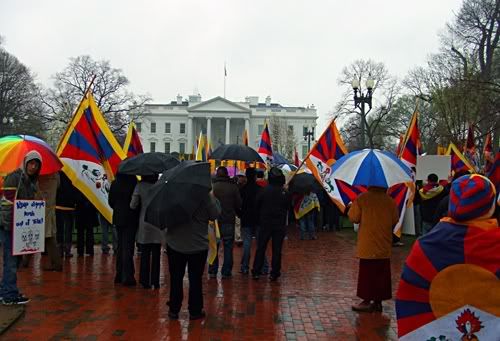
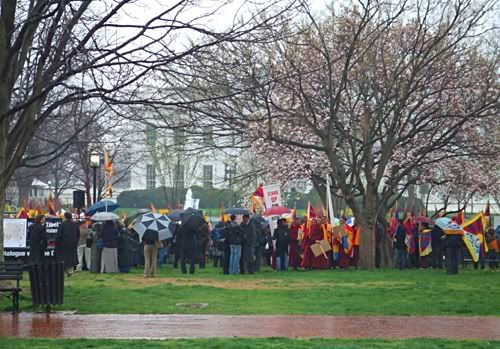
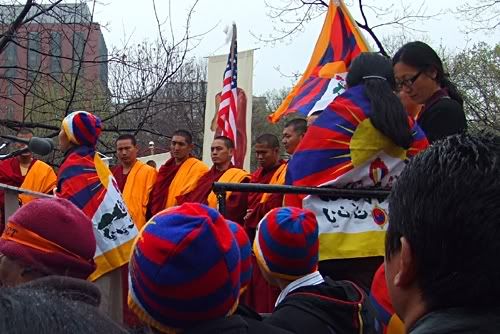
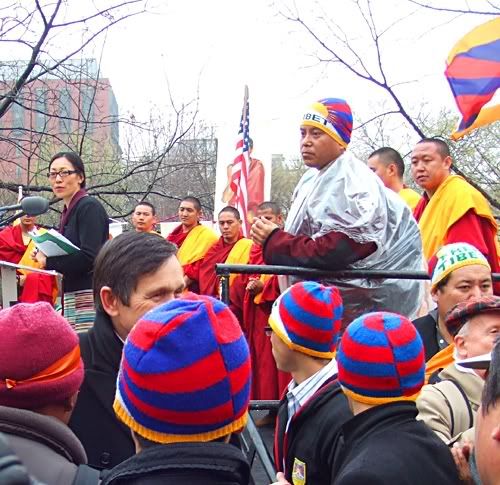
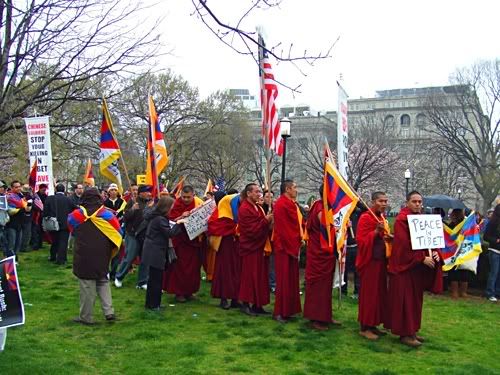
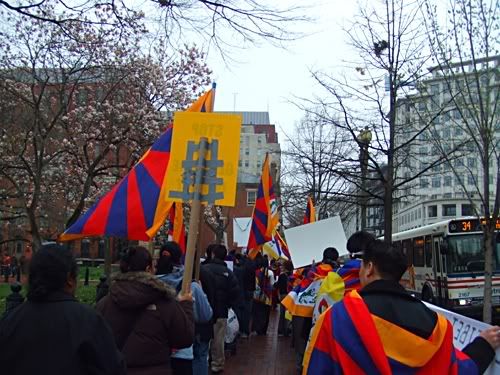
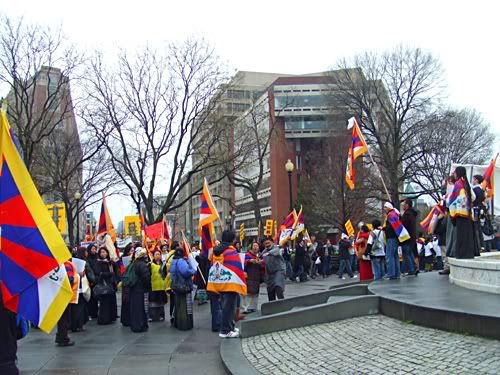
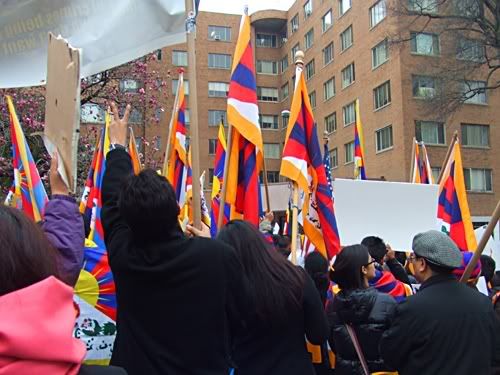
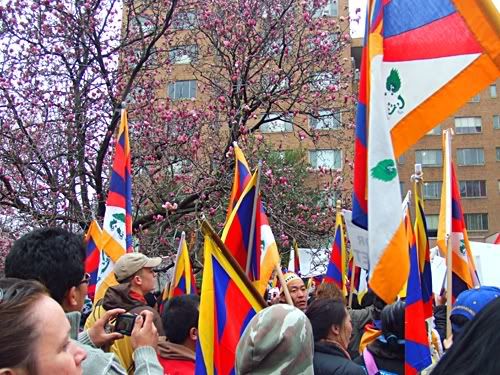
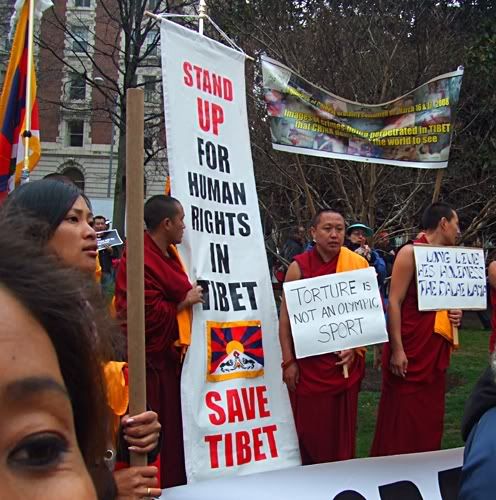
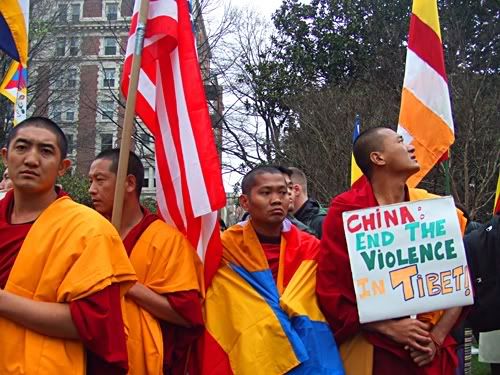
Yesterday, a large group of Tibetans, Americans of Tibetan ancestry, and other American supporters gathered at Lafayette Park outside the White House in Washington, DC to ask President Bush to make a statement for human rights and refused to attend the opening ceremonies of the Beijing Olympics in protest of Chinese government oppression of Tibet.

I have been very moved by the mostly nonviolent struggle of the Tibetans to regain their freedom, and by the strength and compassion shown by the Dalai Lama in urging them to maintain nonviolence at all times. I decided it was important to go and stand in solidarity with them. This is my report on the event.


The plan for the day was to meet at Lafayette Park, hear some speakers, and then march up Connecticut Avenue to the Chinese Embassy, which is just before the bridge that goes over Rock Creek Park. If you're not familiar with DC, I can tell you this is a fairly long walk. I didn't take any notes, but I did take a lot of pictures and a few videos, so this will be a very visual report.


When I first arrived at Lafayette Park, the event really hadn't started, but people were standing facing the White House and chanting slogans like "Free Tibet Now," "China is a liar," and "Long live the Dalai Lama!"

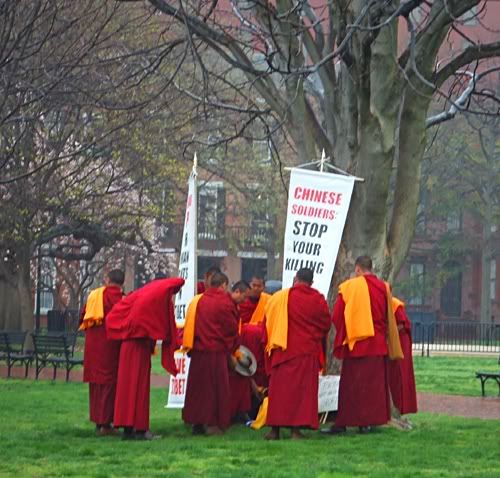
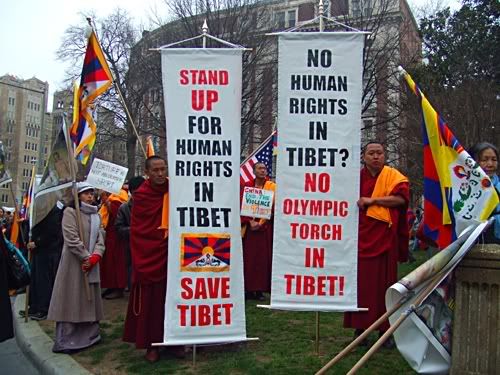
As I approached the gathering, a small cluster of Tibetan monks stood together and apart from the crowd with their banners. Maybe they were praying, or maybe they were just planning their involvement in the event. I was happy to see them. Buddhist monks always seem to have such a nice calm energy. I am slightly mystified by why I like them so much. Perhaps it's because they preach compassion and seem to do an admirable job of practicing it too. I just know that I feel like my heart opens just a little bit more every time I see Tibetan monks. I was saddened to see the messages on the banners they carried.


I stood with the rest of the crowd and chanted the slogans with them as best I could. Sometimes I had a little bit of trouble understanding what they were saying, either because the person leading the chant was shouting a little too loudly for his voice, or because of the accents and the general confusion of crowd noise. I wasn't there too long before the crowd started a mass movement in one direction, so I followed them, and we gathered around a stage that I hadn't noticed before.


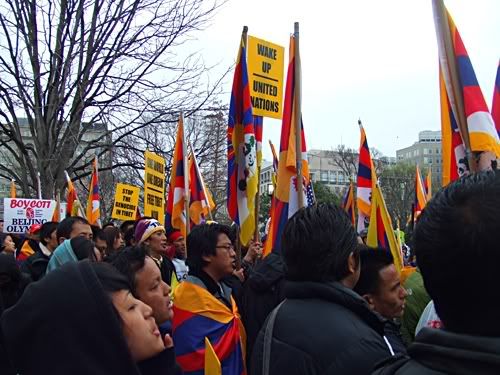
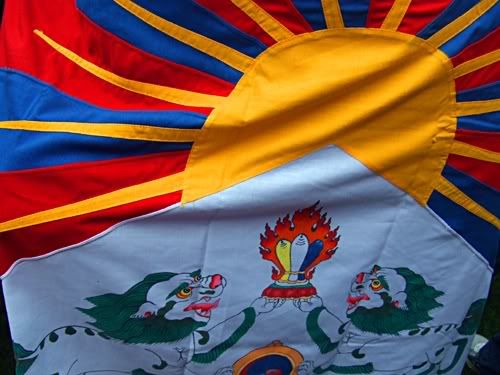
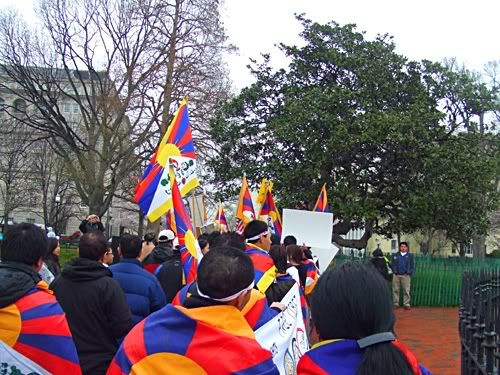
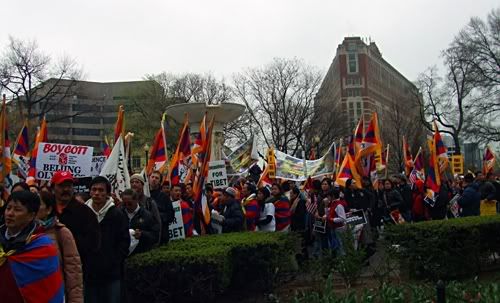
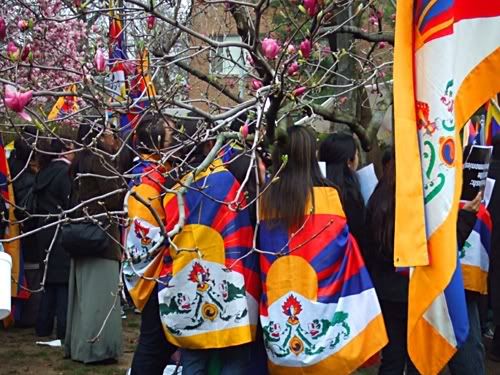
The crowd around me was very colorful, or perhaps I should say very united in their color choices. Many of them carried or wore the flag of Tibet, often draped around their shoulders like a cape.


The first speaker described the current situation in Tibet, in which the exiled Tibetan government says there have been at least 140 people killed. The Tibetan government has released the names of 40 of them, and many people in the crowd held signs with these names on them.


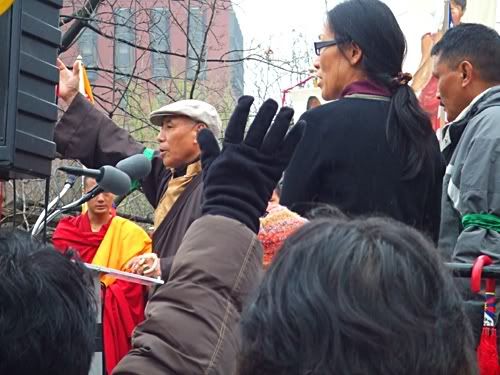
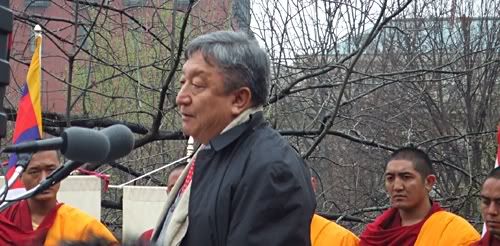
Several other speakers followed, many of them from various Tibetan organizations in the United States. There was also a speaker from Amnesty International. U.S. Representatives Abercrombie of Hawaii and Kucinich of Ohio also spoke.


Representative Abercrombie had been to Dharamsala, India with the congressional delegation led by Nancy Pelosi to meet with the Dalai Lama. Representative Kucinich had also met with the Dalai Lama when he was in the United States to receive the Congressional Medal of Honor, and he spoke about that meeting and also the great opportunity for the world and for China to learn nonviolence and compassion from the Tibetan people.


I have to apologize for the quality of my videos. I was standing on the side of the stage, and often could not see the speakers. Anyway, here is at least a partial picture of Dennis as he left the stage.


A few times the speakers spoke in Tibetan, and there was some singing in Tibetan, including what I think they called the Tibetan National Uprising Song. There is a portion of the end of that in the first video.

Although I didn't understand everything that was said, it is very clear that a harsh injustice is being done to these people and their friends and families in Tibet. Several times the speakers brought me to tears.

Some of the speakers mentioned the missing Panchen Lama, who disappeared when he was just a young boy and is believed to be a political prisoner in China.


There is also a serious environmental concern here, because China is doing a lot of mining in Tibet and is dumping nuclear waste in Tibet, according to some of the speakers at the event. If you saw Al Gore's An Inconvenient Truth, then you may remember that 40% of the world's water comes from the Himalayas. What China is doing in Tibet is polluting the water at the source for many people that live downstream.


One of the speakers was an emissary from the Dalai Lama, who reminded the crowd that Tibet has the world's sympathy because of their nonviolent approach, and urge them to have patience and maintain nonviolence at all times. He also spoke about encouraging signs in Europe and the United States that the world may be ready to help Tibet. I didn't catch the man's name, but the Washington Post says he was Lodi Gyaltsen Gyari.


After the speeches were over, people began to line up for the march up Connecticut Avenue to the Chinese Embassy. The monks led the way.


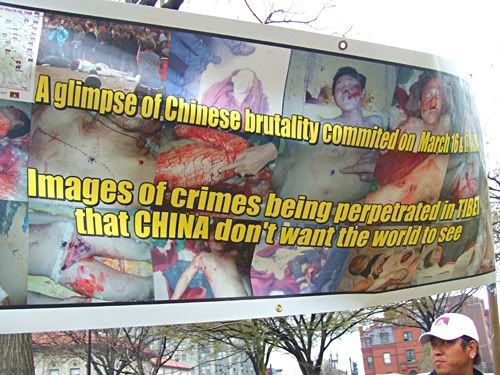
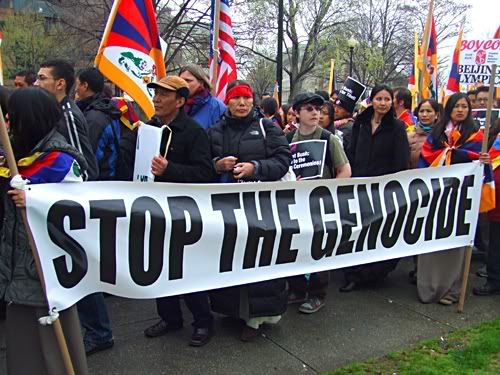
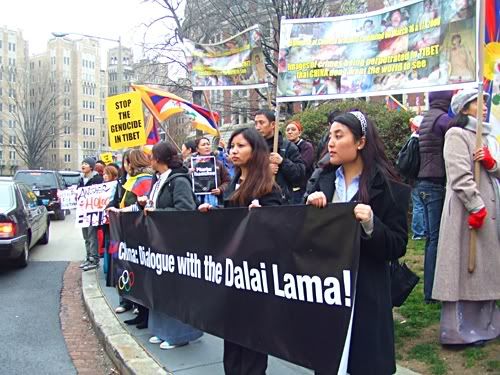
There was more chanting of slogans as we walked in our long procession. Many people driving by honked at us in support. Some people carried banners that bore photos of recent Chinese atrocities.


We stopped for a rest when we got to Dupont Circle, probably partly because it was a very visible location for people driving by, but also because it was time for lunch. This may be the only big protest I've ever been to where the organizers fed everyone. How cool is that? They really took care of us. It was only bread, granola bars, water, and a bit of chocolate, but people need something when they are marching for that long, and it was kind of the event organizers to think of that.


Soon it was time to continue toward the Chinese Embassy.


We arrived at the embassy and gathered on to a little patch of garden in front of it. The big colorful crowd continued to chant slogans as a few people watched us from the embassy windows, and passing cars honked in support.


As the monk's banner in that last photo points out, there is an issue about the Olympic torch going through Tibet. Right now, China plans to have the Olympic torch go through Tibet, which is a slap in the face of the Tibetan people while they are living under oppression. The Olympics are supposed to be a symbol of international cooperation and friendship. To have it run through Tibet while Tibet is being brutally oppressed by a foreign dictatorship is not in the Olympic spirit, and it is an insult to the Tibetan people because it ignores the fact that they are not free.

Please help by signing this petition to keep the Olympic torch out of Tibet.

UPDATE:

The Dalai Lama has issued letters to the Chinese people all over the world, and to the world and its leaders.

The letter to the Chinese people express is the Dalai Lama's willingness for Tibet to remain part of China, as long as the grievances of the Tibetan people can be addressed. It shows great compassion to the Chinese people.

Today, I extend heartfelt greetings to my Chinese brothers and sisters around the world, particularly to those in the People’s Republic of China. In the light of the recent developments in Tibet, I would like to share with you my thoughts concerning relations between the Tibetan and Chinese peoples, and make a personal appeal to all of you.

I am deeply saddened by the loss of life in the recent tragic events in Tibet. I am aware that some Chinese have also died. I feel for the victims and their families and pray for them. The recent unrest has clearly demonstrated the gravity of the situation in Tibet and the urgent need to seek a peaceful and mutually beneficial solution through dialogue. Even at this juncture I have expressed my willingness to the Chinese authorities to work together to bring about peace and stability.

Chinese brothers and sisters, I assure you I have no desire to seek Tibet’s separation. Nor do I have any wish to drive a wedge between the Tibetan and Chinese peoples. On the contrary my commitment has always been to find a genuine solution to the problem of Tibet that ensures the long-term interests of both Chinese and Tibetans. My primary concern, as I have repeated time and again, is to ensure the survival of the Tibetan people’s distinctive culture, language and identity. As a simple monk who strives to live his daily life according to Buddhist precepts, I assure you of the sincerity of my personal motivation.

I have appealed to the leadership of the PRC to clearly understand my position and work to resolve these problems by “seeking truth from facts.” I urge the Chinese leadership to exercise wisdom and to initiate a meaningful dialogue with the Tibetan people. I also appeal to them to make sincere efforts to contribute to the stability and harmony of the PRC and avoid creating rifts between the nationalities. The state media’s portrayal of the recent events in Tibet, using deceit and distorted images, could sow the seeds of racial tension with unpredictable long-term consequences. This is of grave concern to me. Similarly, despite my repeated support for the Beijing Olympics, the Chinese authorities, with the intention of creating a rift between the Chinese people and myself, the Chinese authorities assert that I am trying to sabotage the games. I am encouraged, however, that several Chinese intellectuals and scholars have also expressed their strong concern about the Chinese leadership’s actions and the potential for adverse long-term consequences, particularly on relations among different nationalities.


This is a very long letter, but it is worth reading in full.

The letter to the world explains what the Dalai Lama is asking of each of us and our leaders.

I therefore appeal for your continued support in calling for an immediate end to the current crackdown, the release of all those who have been arrested and detained, and the provision of proper medical treatment. We are particularly concerned about the provision of adequate medical facilities, as there are reports of many injured Tibetans being afraid to go to Chinese-run hospitals and clinics.

I would also request you to encourage the sending of an independent international body, to investigate the unrest and its underlying causes, as well as allow the media and international medical teams to visit the affected areas. Their presence will not only instill a sense of reassurance in the Tibetan people, but will also exercise a restraining influence on the Chinese authorities.


I continue to be inspired by this great man and hope that his kindness and compassion can be an inspiration to the world to solve this problem and create new bonds of friendship. As he says to the Chinese:

However, instead of cultivating enmity towards the Chinese leaders responsible for the ruthless suppression of the Tibetan people, I prayed for them to become friends, which I expressed in the following lines in a prayer I composed in 1960, a year after I arrived in India: “May they attain the wisdom eye discerning right and wrong, And may they abide in the glory of friendship and love.”

Labels: , , , , , , , , , , , , , ,

Saturday, March 29, 2008

A Beginner's Research on Tibetan Buddhism and History

In one of those synchroncities that sometimes occur in life, shortly before I began to hear about the current unrest in Tibet, I had begun to read a book called The Essential Dalai Lama: His Important Teachings, edited by Rajiv Mehrotra and published by Penguin Books. The book is a compilation of essays and lectures on Buddhism by the Dalai Lama. It is a relatively thin book, under 300 pages, but I have yet to finish it a couple of weeks later, because each of the essays in the book is so full of meaning and deserving of further thought that I cannot read too much of it at once without stopping to absorb and ponder it.

I am not a Buddhist. I am someone who has a great deal of interest in spiritual questions about the actual nature of reality, but because of a questioning mind I have been unable thus far to accept any religion. As such, I am by no means an expert on this subject, but I want to convey some sense of what I believe is the deep importance of preserving the Tibetan culture. I have the impression that many Americans are unfamiliar with that culture and think of Tibet as far away and unimportant to them. I want to express why I think it is imperative that we support Tibet.

Buddhism seems to be a mental discipline at least as much as it is a religion. A person following the Buddhist path seeks to achieve victory over the enemy within, which is ignorance that distorts the perception of reality and leads to harmful behavior and suffering for oneself and others. An early step on this path is to learn to control one's passions, emotions, thoughts, and desires so that one causes no harm. The ultimate goal is the liberation from suffering of all sentient beings in the universe through attainment of Buddhahood.

To quote the Dalai Lama:

Buddhism teaches that the mind is the main cause of our being reborn in the cycle of existence. But the mind is also the main factor that allows us to gain freedom from the cycle of birth and death. This liberation is achieved by controlling negative thoughts and emotions and by promoting and developing those that are positive.

-The Essential Dalai Lama p. 68


What if the United States could be transformed from a militaristic culture continually attacking other nations and causing much harm into a peaceful nation that only seeks a better future for all?

It seems like such a very distant goal sometimes, yet that is exactly what happened in Tibet within two or three centuries after the introduction of Buddhism there. Buddhism taught an ethic of caring for others and wanting to bring about their happiness. It was widely adopted, and Tibet went from a warrior culture to a peaceful, spiritual culture in a relatively short period of time. I learned this incredible fact from the second in a series of video lectures On Tibet by Robert Thurman, President of Tibet House U.S. I rented it from Netflix.

Through training our minds we can become more peaceful. This will give us greater opportunities for creating the peaceful families and human communities that are the foundation of world peace. With inner strength, we can face problems in the familial, societal and even global levels in a more realistic way. Nonviolence does not mean passivity . We need to solve problems through dialogue in a spirit of reconciliation. This is the real meaning of nonviolence and the source of world peace.

This approach can also be very useful in ecology. We always hear about a better environment, world peace, nonviolence and so forth, but such goals are not achieved through the application of regulations or United Nations resolutions; it takes individual transformation. Once we have developed a peaceful society in which problems are negotiated through dialogue, we can seriously think about demilitarization -- first on the national level; then on the regional level; and finally on the global level. However, it will be very difficult to achieve these things unless individuals themselves undergo a change within their own minds.

-The Essential Dalai Lama p. 35


Surely a culture that has made this much progress on creating a really civilized nonviolent society is worth preserving. I would even venture to argue that if world peace would be the ultimate worldly outcome of widespread adoption of Buddhist philosophy, then from a purely material world perspective, it almost doesn't matter if the more subtle metaphysical aspects of Buddhism are true. (Of course, from a spiritual perspective it probably matters greatly.)

Who is the Dalai Lama?

His Holiness the Dalai Lama is the spiritual leader of the Tibetan people and the head of the Tibetan Buddhist religion. He is also their political leader, and, as I found out from an A&E Biography of him, he is actually the King of Tibet, a country which from a real-world political perspective at this time exists only in exile. (The land that was once the country of Tibet and is still home to most of the Tibetan people is now politically a part of China, since their invasion and occupation starting in 1950.)

"Dalai Lama" is a title, not a name. His name is Tenzin Gyatso, and he is the 14th Dalai Lama. He is believed to be the reincarnation of every other Dalai Lama there has ever been.

Buddhahood is not the exclusive preserve of the historical Buddha, but a state of insight and being accessible to all humans. Though the Dalai Lama himself is at pains to stake no such claim, describing himself as merely a "simple Buddhist monk," millions of his followers, both Tibetans and others, regard him as a "Living Buddha," a reincarnation of the compassionate --Avalokteshvara, the 14th incarnation in the line of Dalai Lamas , Bodhisattvas who chose to reincarnate to provide temporal leadership to Tibetans and to serve and teach all humanity.

-Rajiv Mehrotra


In the A&E Biography there was a fascinating story about how the 13th Dalai Lama somehow knew that there were going to be problems with China and told the Tibetan people that he would die at an earlier age than would otherwise be necessary, so that he could come back in time to be of an age to be helpful to them in the next life. He then died.

After the 13th Dalai Lama's death, the monks looked for signs of where to find his reincarnation. The young boy who would become the 14th Dalai Lama lived in a rural area and often would play a game of packing a bag and saying he was going to Lhasa, the Tibetan capital where the Dalai Lama normally lived. When the monks eventually found him, he was able to correctly identify a series of objects that had belonged to the 13th Dalai Lama and which he had never seen before in his current incarnation. This is also shown in the very fine Martin Scorsese film Kundun, which tells the story of the current Dalai Lama's early life.

The young Dalai Lama was rigorously trained in Buddhism and was crowned King of Tibet as a teenager. After the Chinese invaded his country in 1950, he at first sought to coexist peacefully with them, even making visits to China to meet with Chairman Mao. The Chinese apparently made sweet promises to him about modernizing Tibet, which he liked because he had an interest in technology.

Whatever misgivings he may have had, he was also obligated to approach them in the spirit of nonviolence. Eventually, it became clear to him that the Chinese government was bent on the destruction of Tibetan religion and culture, and he was forced to flee his homeland in 1959. Since then he has lived in Dharamsala, India, which is the seat of the Tibetan government in exile.

To Americans, it may seem strange to think of a government headed not only by a king, but one who is a religious leader as well. The current Dalai Lama is, however, a very modern man. Although he remains the leader of the Tibetan people, he's apparently a great admirer of democracy and Thomas Jefferson, and after he was exiled, he wrote a democratic constitution for Tibet that even allows for his impeachment. The concept of impeaching him apparently caused great consternation among the Tibetan people when it was first published, because they believed this would be sacrilegious.

Clearly a very intelligent person, he is not dogmatic, nor does he insist that Buddhism is the only path. In fact, he regularly meets with prominent religious leaders and scientists from all over the world. In response to a question, he once told Carl Sagan that if science was ever able to prove that reincarnation does not exist, then they would have to stop believing in it. He believes that religion must accommodate itself to whatever science has proven.

Since his exile, the Dalai Lama has traveled all over the world giving lectures and teachings and exchanging knowledge with all sorts of people. He has introduced the Tibetan religion to the world and has therefore become a teacher not only to the Tibetan people, but the entire planet.

I once attended a lecture and meditation given by him in Mountain View, California, and I think that it would be very difficult for anyone who has been in the presence of this great man to deny that at the very least he is a person full of compassion and wisdom.

The Dalai Lama was awarded the Nobel Peace Prize in 1989, for his continued dedication to nonviolence.

The Situation in Tibet

The area traditionally known as Tibet is located high in the Himalayas. It is as large as the portion of the United States west of the Mississippi, and home to 6 million Tibetans. Since the Chinese invasion, it has also been settled by Han Chinese. Tibet is so high in altitude, however, that its population has evolved greater lung capacity to cope with the scarcity of oxygen. The newly arrived Han Chinese settlers do not have this greater lung capacity and therefore face health problems, including the necessity for pregnant women to go back to China to give birth. (Much of this is information I got from Robert Thurman's lecture series, which I mentioned earlier.)

Tibet has long been known as a sacred place throughout Asia, and is more recently gaining that reputation in the United States and Europe. It is thought by some to be the inspiration for the legends about a place called Shangri-La or Shamballa, a Himalayan valley surrounded by high mountains and populated by spiritually enlightened beings. I have also seen Tibet described as the crown chakra of the planet.

Given this holy reputation, I can't help but wonder whether part of the Chinese motivation for invasion and occupation was to either control the spiritual energy there, in sort of the same way that the Nazis sought power from esoteric symbolism, or to suppress belief in that spiritual energy, given the Chinese government's history of being antireligious.

Since the Chinese occupation, the Chinese government has sought to destroy Tibetan culture, buildings, and artifacts, including some Buddhist monasteries. They have modernized, but also commercialized the Tibetan landscape. They have also reportedly turned the Tibetan people into an economically deprived lower-class.

There have been various uprisings and protests over the years. The current unrest is the most significant in years. It began on March 10, the anniversary of the 1959 uprising of the Tibetan people against the Chinese government, during which the Dalai Lama fled to India. It also comes on the eve of this year's Summer Olympics, which will be hosted by China. The Olympics will shine a spotlight on China, so it is an important time to raise awareness of human rights violations by the Chinese government.

Many people have already been killed by the Chinese government in the current Tibetan uprising. The Tibetans who are joining the protests are doing so even though they realize that they risk losing their lives. It is important for America, which proclaims the ideal of freedom, to walk our talk and support Tibetan freedom.

Since the current uprisings began, I have been doing background research more than I have been following the day-to-day events. For more on what is currently happening, please see grannyhelen's excellent series of diaries.

On March 31, there is a Global Day of Action for Tibet planned in many cities throughout the world. I will be joining the march from the White House to the Chinese Embassy in Washington, DC.

If you haven't already, please sign the petition in support of Tibet and the Dalai Lama at avaaz.org.

Labels: , , , , , , , , ,