Observing from beyond the solar system, a cultural outsider looks in.

Monday, November 17, 2008

10 Goals for the Obama Administration

I struggled with the title of this piece. I was going to call it "10 things I expect from the Obama administration," but I don't actually believe Obama will do even half of these. Nevertheless, they are all vital to the health of our nation and necessary if we are going to truly get on the right track. I considered calling it "10 things the Obama administration should do," but that minimizes the necessity of these steps. I considered calling it "10 things the Obama administration must do," but in reality, many of these things will probably not be accomplished in eight years. Nevertheless, they are the direction we must be moving.

This is my personal manifesto on the most important goals for our nation. As you read this opinion piece, remember, I don’t believe I'm asking for too much. I'm demanding the minimum I believe we all deserve from our leaders. The fact that many of these goals seem far off and nearly impossible for Obama to achieve is only evidence of how badly our previous leaders have failed us. I’m not saying these will be easy for Obama, or that he will achieve them. I’m saying they need to be goals he has clearly in sight and he must work persistently toward them.


  1. Restore our Constitution. After eight years of the Bush administration, I don’t recognize this country anymore. We’ve seen things happen that I didn’t think could ever happen in America --- very bad things.

    We’ve seen the probable theft of two elections. We’ve seen people arrested and held without due process of law and without their right of habeas corpus. We’ve seen a mockery made of our right to peaceably assemble, with protestors being confined to fenced-in “free speech zones” that look a lot like makeshift prisons. We’ve seen the phones of American citizens bugged, dissidents and journalists harassed and arrested.

    We’ve seen the Patriot Act attempt to codify many of these abuses into law, although a sane Supreme Court (which we don’t have right now) could not help but find some of its provisions unconstitutional. We’ve seen the president assert a right to dictator-like executive powers and make preparations that would allow him to declare martial law and deploy the national guard against American citizens.

    Those of us who have been paying attention to real events not necessarily reported by the corporate media have seen those things, anyway.

    We need action to restore the Constitution in the first 100 days of the Obama administration.

    We need a resounding return to the rule of law. We need Obama to give up the excessive executive powers claimed by Bush. We need an immediate legislative review of all national security legislation enacted during the Bush administration with a strict eye to restoring the Bill of Rights and the checks and balances in the Constitution.

    We need an end to the nonsense about sacrificing our liberties for national security. Without our liberties, where is our nation? The truly valuable aspects of America only ever existed as revolutionary ideas about liberty and human rights in the first place. Without those ideas, America has nothing much of real value to offer the world. There is no law higher or more sacred in America than the Bill of Rights and the Constitution. We need to affirm that, cherish it, restore it, and uphold it.

    Is the Constitution perfect? No. It certainly wasn’t when first enacted and, though amendments have vastly improved it, it isn’t perfect now. I can certainly see the need for additional amendments to spell out the right of each citizen to vote and have their vote counted accurately, the equality of rights for all citizens, and the facts that corporations are not persons and money is not speech. But those potential amendments largely fall into the category of “spelling things out for people who are too dim to get it and have obviously been tragically deprived of the use of a good dictionary, unfortunately including some Supreme Court Justices.”

    Even in the imperfect state where it stands, the Constitution is the highest law of the land and a good basis for our society. Nobody should be above that law, including the president.

    If you agree that restoring the Constitution must be step 1, please sign People for the American Way’s petition.


  2. Kick the lobbyists out of Washington. Ask yourself how we got into this mess, how we got so far off track, how government officials stopped serving the public they are supposed to represent. If you think about it for long and you know how Washington works, you can’t help eventually coming to the conclusion that much of the fault lies with corporate lobbyists who are allowed by current laws to essentially bribe our elected representatives to do whatever suits their corporate clients.

    Lobbyists have far more access to our elected representatives than we do. Much of the legislation enacted by Washington is written by them. Campaigns are funded by them, with the clear expectation of a return on the investment once the candidate gets elected. Lobbying firms promise well-heeled clients access to our representatives, and they can promise that because they can get it.

    Former lobbyists go to work for elected officials. Former elected officials and their staff members go to work for lobbying firms. The closeness is incestuous, and it’s destroying our democracy.

    Obama made a major campaign promise to clean up this mess. He needs to do that with real reforms, not just the appearance of reform.


  3. Guarantee election integrity. In 2000, the Supreme Court prevented Florida from having a meaningful recount so the theoretically impartial Court could throw the election to their preferred candidate. In 2004, systematic voter suppression resulted in legitimate voters being thrown off voter rolls or prevented from registering, as well as absurdly long lines in Democratic precincts in Ohio. In addition, there was probably voting machine tampering in several key states.

    In both cases, the election seems almost certainly to have gone to the wrong candidate. Together, these two election thefts resulted in the disaster that was our eight year long national nightmare of the Bush administration. We are in the horrible mess we’re in now because of depredation by a president who was most likely never legitimately elected --- in America, a country which prides itself on its democracy.

    We must never allow another election theft.

    To date, there is no nationwide voting system. The task of holding elections has been left up to states and municipalities by the Constitution. This is probably as it should be, since it prevents nationwide implementation of a fraudulent system just as much as it prevents nationwide implementation of a good system. I think, however, that it is time for some national guidelines on the minimum requirements for reliable, transparent elections.

    If voting machines are to be used, they must allow the voter to vote on paper and the paper ballot must be saved in case of a recount. In case of a discrepancy, the paper ballot must be the official record, which means the paper ballots must be carefully guarded and preserved. Ballots may be counted by a machine, such as in an optical scan system, but there must be a way to verify that the counting is done correctly, otherwise the count can be changed within the machine and you’d never know it unless a manual count of the paper ballots is done.

    The best way to allow verification that the counting algorithm is working correctly is to disallow proprietary source code and require open source code that can be inspected by interested parties. Proprietary source code means that a private company can keep the method they use for counting votes secret. The danger of privatization of our elections is illustrated by the incident with the chief executive of Diebold, Walden O’Dell, who in 2003 pledged to deliver Ohio to Bush. Diebold keeps its source code secret, so this could have easily been accomplished using an algorithm that would switch votes within the computer.

    Open Voting Consortium is on the forefront of developing open source, voter verifiable voting systems. They should be sought out for their input on voting system implementation.

    Citizens over 18 must be allowed to vote.

    There need to be some stiff penalties created to punish people who deliberately prevent voter registration, purge voter rolls, and try to suppress the vote. Voting rights laws need to be given some teeth so that crimes involving voter suppression are actually punished. The right to vote can be guaranteed nationwide, and the Voting Rights Act needs to be strengthened.

    Some citizens have trouble getting to the polls on election day because they must work. We should make it easy to vote by allowing early voting nationwide. Other measures to encourage participation should also be considered.

    Of course there need to be safeguards to ensure that each citizen only votes once, but such safeguards must be implemented without suppressing the vote. Checking to make sure that new registrations are for real people who are citizens over 18 and then having some sort of poll book system that prevents voting twice should be sufficient to prevent fraud by ballot stuffing. Some groups have sought to suppress legitimate voting under the guise of “preventing voter fraud.” This kind of anti-democratic activity must not be tolerated.

    America’s highest value is democracy. We must live up to that ideal by actively encouraging all citizens to vote. Deliberate interference with the democratic process must be punished as the worst kind of crime.


  4. Stop the war profiteering. If there’s one good thing that’s come out of the past eight years, it may be the shattering of our illusions that American military operations are generally conducted for noble reasons like spreading democracy and releasing people from oppression. I know my own remaining illusions about this have been shattered.

    The sad reality is that America too often goes to war to create economic opportunities for American corporate interests. This has been the case for many years, but the Bush administration has taken war profiteering to a whole new level by increasingly privatizing the military so that private military contractors like Halliburton and Blackwater can get an even bigger slice of the death and destruction pie.

    America is a nation that kills people for profit. Yes, it’s a nasty and shocking thing to say. It’s also true. Let’s change that. Please, America, let’s collectively change that, because I can’t bear the thought of what this evil is doing to our national soul.

    I know that if you haven’t already understood the fact of American war profiteering, it’s a bitter pill to swallow. Some folks are no doubt in denial about it. You may want to watch Robert Greenwald’s recent documentary Iraq for Sale, or in case you just can’t take it without some sick, dark comedy, check out John Cusack’s War, Inc. If you opt for the fictional, satiric version, though, just remember that though the details may be changed for comedic effect, at a basic level, War, Inc. is telling the truth.

    Obama, like presidents before him, will be under tremendous pressure to continue the war for profit racket. It will take extreme courage and persistence to put an end to it. Nevertheless, this must be done.


  5. Level the financial playing field and restore our nation to economic health. Rampant deregulation and letting corporations run wild in the name of a “free market” has been the Republican mantra for at least 30 years or so. It hasn’t worked. In fact, it has caused the financial crisis we’re in right now.

    Let’s get one thing straight: the idea that corporations are going to naturally look out for the good of the entire nation instead of merely their own bottom lines is just silly. Nevertheless, it has been the basis of Republican policy for decades. We’re paying for that folly now.

    Obama needs to lead the way to a saner economic policy that includes sensible regulation of the financial industry to rein in corporate greed. He needs to help America’s financial picture to get back in the black by working from the bottom up this time. That means finding ways to put people back to work and help them save.

    He should take a cue from FDR, whose WPA policies helped end the great depression, began the work of getting America back on a sound financial footing, and lifted millions of Americans out of poverty.


  6. Commit to an 80% reduction in carbon emissions by 2050. This is a target that should prevent the worst effects of global warming, although we are already too late to prevent all the effects of global warming. Major side benefits of this goal are the creation of green jobs and getting our country off its dependence on foreign oil. Add the fact that it seems unlikely many of us will survive without this commitment, and you’re left with no coherent argument against this goal.

    The Obama Administration must make a major investment in developing clean and safe alternative energy sources, and that means major scientific research grants.

    Start to make the carbon emissions reduction a reality without resorting to “clean coal" and "safe nuclear," which are currently oxymorons that will result in giveaways to the coal and nuclear industries. Now, I’m not saying that I’m unwilling to be convinced by strong scientific progress on the safety of these technologies, but neither of them is there yet, and any construction of coal-based or nuclear plants must be stopped until the technologies are safe and clean. In the case of nuclear, I doubt very much that it will ever be safe, because the half-life of nuclear waste leaves no room for human error of any kind.


  7. Equal rights for all. Obama could not have been elected without the work done by the civil rights movement in earlier decades. It's time to fulfill the promise of the civil rights movement and guarantee equal rights for all regardless of race, gender, sexual preference, or ethnicity.

    This means making the social and economic changes that will allow historically oppressed African Americans to finally climb out of poverty and disenfranchisement. That means a commitment to affirmative action, guaranteed voting rights, and excellent public education in all public schools.

    It means equal pay and equal opportunity for women. This includes a commitment to women's reproductive rights, so that women can decide for themselves when it's time to make the potentially financially devastating decision to have children. It also means child care and education services to support children who are here and prevent single mothers from falling into poverty.

    It means all consenting adults must have the right to marry as they choose, including all the legal and social benefits that entails. It also means hate crimes laws need some teeth, so we prevent violence against anyone based on race, gender, sexual orientation, or ethnicity.

    It means we need to stop discrimination based on ethnicity or creed, too. It is not a crime to be a Muslim, an Arab, Hispanic, an atheist, or any other ethnic or belief background. Our schools need to teach tolerance and understanding of others so that we learn to assess individuals on their merits, not make judgments about them based on their ethnic background or creed.


  8. Universal health care. Health care is a human right. Period. Every person in America needs to be guaranteed quality health care. In the end, this will be cheaper than the snarling Hydra of our current monstrous insurance-based non-system. We can debate about how to do it, but it needs to get done. For-profit health care must end. We are talking about the rights of human beings, and they are not for sale.


  9. Restore the function of a free press. Without a free press, we can’t have an informed populace. Without an informed populace, we can’t make the right decisions about our future. A free press means all points of view can be expressed, not just those of moneyed corporate interests.

    We cannot have a free press when five corporations control almost all of the media in this country and they promote or suppress stories based on what serves their other interests. These corporations are conglomerates, and that means they have financial interests in other kinds of industries besides just media and entertainment. Some of them have financial interests in military contractors, for example. Is it any wonder they conspired to sell us the Iraq war?

    Restoring a free press is going to take rethinking of laws that govern the media to promote independent media outlets. It is going to take grants to develop independent media. And it is going to take some major corporate trust-busting. It won’t be easy, but a free press is a right that is guaranteed to us by the first amendment, and it must be restored.


  10. Reverse corporate personhood. I don't expect this to happen overnight. It will take a reversal of the disastrous, wrongheaded Supreme Court decision that declared corporations are persons in the first place. That means any Supreme Court Justice that Obama picks MUST see the ridiculousness of that proposition. Luckily, they have me and my fondness for noticing absurdity.

    For anyone not familiar with corporate personhood, it is the asinine legal concept that says that a corporation is a person and therefore has the same rights under the law as an individual (but not the same responsibilities, or else our prison system would be filled with tobacco companies, pharmaceutical companies, health insurance companies, and defense contractors convicted of murder). Let me show you how ridiculous the concept of corporate personhood really is.

    If corporations were persons, I'd be trying to get Ben & Jerry's to marry me. After all, they share my progressive values, they taste sweet, and they don't care if I gain weight. On second thought, I don't want to marry Ben & Jerry's. They make me look fat.

    As long as certain members of our society are over-concerned about the gender of people who marry, how do you assign gender to a corporation, anyway?

    Let's pretend for a moment that I care about fashion and I have a particular designer whose corporation makes clothes I love. Let's say it's Vera Wang. Now, I want to marry Vera Wang's corporation, but surely with a name like Vera Wang, it's a female corporation. Looks like the proposition 8 supporters will be against that, although I'm not sure they would be any happier with a man who wanted to marry the corporate personhood of Vera Wang. Come to think of it, I don't want to marry Vera Wang, Inc. This dress makes me look fat.

    There you have it. You can't invite a corporation into your home, feed it ice cream, serve it tea, or seduce it into your boudoir, no matter what your sexual preference, no matter how lucky you get, and no matter how sexy their shoes are. Therefore, corporations are NOT persons.

    Putting an end to corporate personhood is essential. If you read through this list of goals, each one of them has some relationship to the fact that corporations have managed to grab way too much power over our government.

    Some of these relationships are more obvious than others, but even in the case of human rights and equality issues, greedy corporate interests know that as long as we fight among ourselves and as long as our political power is held in check, we the people can’t take back control of our own government.

    Our government is supposed to be a government of the people, by the people, and for the people. People may work for corporations, but corporations are not people and corporate interests should not run our government.


Labels: , , , , , , , , ,

Saturday, March 29, 2008

A Beginner's Research on Tibetan Buddhism and History

In one of those synchroncities that sometimes occur in life, shortly before I began to hear about the current unrest in Tibet, I had begun to read a book called The Essential Dalai Lama: His Important Teachings, edited by Rajiv Mehrotra and published by Penguin Books. The book is a compilation of essays and lectures on Buddhism by the Dalai Lama. It is a relatively thin book, under 300 pages, but I have yet to finish it a couple of weeks later, because each of the essays in the book is so full of meaning and deserving of further thought that I cannot read too much of it at once without stopping to absorb and ponder it.

I am not a Buddhist. I am someone who has a great deal of interest in spiritual questions about the actual nature of reality, but because of a questioning mind I have been unable thus far to accept any religion. As such, I am by no means an expert on this subject, but I want to convey some sense of what I believe is the deep importance of preserving the Tibetan culture. I have the impression that many Americans are unfamiliar with that culture and think of Tibet as far away and unimportant to them. I want to express why I think it is imperative that we support Tibet.

Buddhism seems to be a mental discipline at least as much as it is a religion. A person following the Buddhist path seeks to achieve victory over the enemy within, which is ignorance that distorts the perception of reality and leads to harmful behavior and suffering for oneself and others. An early step on this path is to learn to control one's passions, emotions, thoughts, and desires so that one causes no harm. The ultimate goal is the liberation from suffering of all sentient beings in the universe through attainment of Buddhahood.

To quote the Dalai Lama:

Buddhism teaches that the mind is the main cause of our being reborn in the cycle of existence. But the mind is also the main factor that allows us to gain freedom from the cycle of birth and death. This liberation is achieved by controlling negative thoughts and emotions and by promoting and developing those that are positive.

-The Essential Dalai Lama p. 68


What if the United States could be transformed from a militaristic culture continually attacking other nations and causing much harm into a peaceful nation that only seeks a better future for all?

It seems like such a very distant goal sometimes, yet that is exactly what happened in Tibet within two or three centuries after the introduction of Buddhism there. Buddhism taught an ethic of caring for others and wanting to bring about their happiness. It was widely adopted, and Tibet went from a warrior culture to a peaceful, spiritual culture in a relatively short period of time. I learned this incredible fact from the second in a series of video lectures On Tibet by Robert Thurman, President of Tibet House U.S. I rented it from Netflix.

Through training our minds we can become more peaceful. This will give us greater opportunities for creating the peaceful families and human communities that are the foundation of world peace. With inner strength, we can face problems in the familial, societal and even global levels in a more realistic way. Nonviolence does not mean passivity . We need to solve problems through dialogue in a spirit of reconciliation. This is the real meaning of nonviolence and the source of world peace.

This approach can also be very useful in ecology. We always hear about a better environment, world peace, nonviolence and so forth, but such goals are not achieved through the application of regulations or United Nations resolutions; it takes individual transformation. Once we have developed a peaceful society in which problems are negotiated through dialogue, we can seriously think about demilitarization -- first on the national level; then on the regional level; and finally on the global level. However, it will be very difficult to achieve these things unless individuals themselves undergo a change within their own minds.

-The Essential Dalai Lama p. 35


Surely a culture that has made this much progress on creating a really civilized nonviolent society is worth preserving. I would even venture to argue that if world peace would be the ultimate worldly outcome of widespread adoption of Buddhist philosophy, then from a purely material world perspective, it almost doesn't matter if the more subtle metaphysical aspects of Buddhism are true. (Of course, from a spiritual perspective it probably matters greatly.)

Who is the Dalai Lama?

His Holiness the Dalai Lama is the spiritual leader of the Tibetan people and the head of the Tibetan Buddhist religion. He is also their political leader, and, as I found out from an A&E Biography of him, he is actually the King of Tibet, a country which from a real-world political perspective at this time exists only in exile. (The land that was once the country of Tibet and is still home to most of the Tibetan people is now politically a part of China, since their invasion and occupation starting in 1950.)

"Dalai Lama" is a title, not a name. His name is Tenzin Gyatso, and he is the 14th Dalai Lama. He is believed to be the reincarnation of every other Dalai Lama there has ever been.

Buddhahood is not the exclusive preserve of the historical Buddha, but a state of insight and being accessible to all humans. Though the Dalai Lama himself is at pains to stake no such claim, describing himself as merely a "simple Buddhist monk," millions of his followers, both Tibetans and others, regard him as a "Living Buddha," a reincarnation of the compassionate --Avalokteshvara, the 14th incarnation in the line of Dalai Lamas , Bodhisattvas who chose to reincarnate to provide temporal leadership to Tibetans and to serve and teach all humanity.

-Rajiv Mehrotra


In the A&E Biography there was a fascinating story about how the 13th Dalai Lama somehow knew that there were going to be problems with China and told the Tibetan people that he would die at an earlier age than would otherwise be necessary, so that he could come back in time to be of an age to be helpful to them in the next life. He then died.

After the 13th Dalai Lama's death, the monks looked for signs of where to find his reincarnation. The young boy who would become the 14th Dalai Lama lived in a rural area and often would play a game of packing a bag and saying he was going to Lhasa, the Tibetan capital where the Dalai Lama normally lived. When the monks eventually found him, he was able to correctly identify a series of objects that had belonged to the 13th Dalai Lama and which he had never seen before in his current incarnation. This is also shown in the very fine Martin Scorsese film Kundun, which tells the story of the current Dalai Lama's early life.

The young Dalai Lama was rigorously trained in Buddhism and was crowned King of Tibet as a teenager. After the Chinese invaded his country in 1950, he at first sought to coexist peacefully with them, even making visits to China to meet with Chairman Mao. The Chinese apparently made sweet promises to him about modernizing Tibet, which he liked because he had an interest in technology.

Whatever misgivings he may have had, he was also obligated to approach them in the spirit of nonviolence. Eventually, it became clear to him that the Chinese government was bent on the destruction of Tibetan religion and culture, and he was forced to flee his homeland in 1959. Since then he has lived in Dharamsala, India, which is the seat of the Tibetan government in exile.

To Americans, it may seem strange to think of a government headed not only by a king, but one who is a religious leader as well. The current Dalai Lama is, however, a very modern man. Although he remains the leader of the Tibetan people, he's apparently a great admirer of democracy and Thomas Jefferson, and after he was exiled, he wrote a democratic constitution for Tibet that even allows for his impeachment. The concept of impeaching him apparently caused great consternation among the Tibetan people when it was first published, because they believed this would be sacrilegious.

Clearly a very intelligent person, he is not dogmatic, nor does he insist that Buddhism is the only path. In fact, he regularly meets with prominent religious leaders and scientists from all over the world. In response to a question, he once told Carl Sagan that if science was ever able to prove that reincarnation does not exist, then they would have to stop believing in it. He believes that religion must accommodate itself to whatever science has proven.

Since his exile, the Dalai Lama has traveled all over the world giving lectures and teachings and exchanging knowledge with all sorts of people. He has introduced the Tibetan religion to the world and has therefore become a teacher not only to the Tibetan people, but the entire planet.

I once attended a lecture and meditation given by him in Mountain View, California, and I think that it would be very difficult for anyone who has been in the presence of this great man to deny that at the very least he is a person full of compassion and wisdom.

The Dalai Lama was awarded the Nobel Peace Prize in 1989, for his continued dedication to nonviolence.

The Situation in Tibet

The area traditionally known as Tibet is located high in the Himalayas. It is as large as the portion of the United States west of the Mississippi, and home to 6 million Tibetans. Since the Chinese invasion, it has also been settled by Han Chinese. Tibet is so high in altitude, however, that its population has evolved greater lung capacity to cope with the scarcity of oxygen. The newly arrived Han Chinese settlers do not have this greater lung capacity and therefore face health problems, including the necessity for pregnant women to go back to China to give birth. (Much of this is information I got from Robert Thurman's lecture series, which I mentioned earlier.)

Tibet has long been known as a sacred place throughout Asia, and is more recently gaining that reputation in the United States and Europe. It is thought by some to be the inspiration for the legends about a place called Shangri-La or Shamballa, a Himalayan valley surrounded by high mountains and populated by spiritually enlightened beings. I have also seen Tibet described as the crown chakra of the planet.

Given this holy reputation, I can't help but wonder whether part of the Chinese motivation for invasion and occupation was to either control the spiritual energy there, in sort of the same way that the Nazis sought power from esoteric symbolism, or to suppress belief in that spiritual energy, given the Chinese government's history of being antireligious.

Since the Chinese occupation, the Chinese government has sought to destroy Tibetan culture, buildings, and artifacts, including some Buddhist monasteries. They have modernized, but also commercialized the Tibetan landscape. They have also reportedly turned the Tibetan people into an economically deprived lower-class.

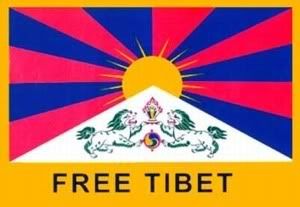
There have been various uprisings and protests over the years. The current unrest is the most significant in years. It began on March 10, the anniversary of the 1959 uprising of the Tibetan people against the Chinese government, during which the Dalai Lama fled to India. It also comes on the eve of this year's Summer Olympics, which will be hosted by China. The Olympics will shine a spotlight on China, so it is an important time to raise awareness of human rights violations by the Chinese government.

Many people have already been killed by the Chinese government in the current Tibetan uprising. The Tibetans who are joining the protests are doing so even though they realize that they risk losing their lives. It is important for America, which proclaims the ideal of freedom, to walk our talk and support Tibetan freedom.

Since the current uprisings began, I have been doing background research more than I have been following the day-to-day events. For more on what is currently happening, please see grannyhelen's excellent series of diaries.

On March 31, there is a Global Day of Action for Tibet planned in many cities throughout the world. I will be joining the march from the White House to the Chinese Embassy in Washington, DC.

If you haven't already, please sign the petition in support of Tibet and the Dalai Lama at avaaz.org.

Labels: , , , , , , , , ,

Wednesday, January 09, 2008

Why I Will Support John Edwards through the Convention and Beyond

I've been away from my home for three weeks. I was in New Hampshire helping the Edwards campaign, then I went to Michigan for Christmas, then I was in Iowa for the caucus. It was a lot of fun, and a lot of hard work. Sometimes it was an emotional roller coaster. Many things happened during that time, but through it all, one thing never changed: I will support John Edwards through the convention and beyond, no matter what.

I was glad to hear him reiterate last night what I first heard him say on George Stephanopoulos’ show: that he plans to stay in through the convention and to the White House. I will support him all the way.


Here's a quote from his speech last night:

Because of those who have called, and knocked on doors, and worked tirelessly on behalf of this cause, this cause to create the America that all of us believe in, because of that, I want to be absolutely clear to all of you who have been devoted to this cause, and I want to be clear to the 99% of Americans who have not yet had the chance to have their voices heard that I am in this race to the convention, that I intend to be the nominee of my party. And I am in this race until we have actually restored the American dream, and strenthened and restored the middle class of America, and so I ask all of you here and all of you who can hear the sound of my voice, the 99% whose voices have not yet been heard in this democracy to join us in this grassroots campaign to create the kind of America that all of us believe in.


This is the first time in my life that I've ever had such utter, unswerving loyalty to a candidate. There are a lot of reasons for it, but I've been struggling as to how to distill it down to the essence so I can communicate the reason to others. It boils down to my principles.

There are certain principles I've held throughout my life, and my support for John Edwards is a vibrant and clear expression of every one of them, because he embodies these principles with his actions and his policies.


Liberty - All Americans, and certainly all American politicians, give at least lip service to Liberty. How many of us really believe in it?

How many of us really believe in freedom of speech, even when we disagree with what is said? How many politicians are willing to show their respect for freedom of speech by being willing to answer hard questions on any subject? John Edwards never tries to silence dissent, and he encourages tough questions.

Edwards is not just passively in favor of freedom of speech, he actively encourages it. Throughout this campaign, he has encouraged bloggers to create political dialogue on the Internet. He has stood up for net neutrality, speaking clearly about the importance of the Internet for our democracy. He has spoken in opposition to media consolidation, even sending a letter opposing media consolidation to the FCC during a public comment period at a time when the FCC was considering adopting rules that would allow further media consolidation.

When you have Liberty, Democracy necessarily follows, since if you are free, you deserve a say in your government. How many of us really believe in democracy, even when we don't like the outcome? How many times have you been told that you have to fall in line and support the front runner, even if you disagree with them? How many times have you been told to support the person with the most cash, because fund-raising is going to determine the outcome? These are profoundly anti-democratic sentiments, but some I've heard them repeated a lot in the past 6 months.

John Edwards has repeatedly stood up for the right of every person to have a voice in this democracy. He has repeatedly stood up for the right of all people to be heard, regardless of whether they have money to give to campaigns. He has supported public financing by taking it himself, and he has never taken a dime from a Washington lobbyist. He is standing up for our right to be heard now, by staying in this race and fighting for the nomination.

Edwards believes in freedom of religion, too. I heard him speak at the Sojourners conference in Washington, DC earlier this year. That was a religious audience, and he didn't pander to them, in spite of the fact that he is religious himself. In fact, he stated clearly that people of all religions and people without a religion all deserve an equal voice in our democracy.

At every turn in this campaign, it seems to me that Edwards has always sought to empower people -- to enfranchise us at a time when we have become so accustomed to disenfranchisement.

Equality - This may be the deepest of my core principles. I haven't always expressed it perfectly, and I haven't even always understood it perfectly, but I know that few things outrage me more than people being treated unfairly and inequitably by others.

I think perhaps a principle takes root more deeply when you have struggled to understand it. I know that when I was a child, the assertion that "All Men Are Created Equal" puzzled me. The first thing I wanted to know was, why was it men? I can still remember my mother telling me that in that case "men" meant all of humanity. Given the sexism of the time when the Declaration of Independence was written, I'm not sure that was really what it meant, but it is certainly the only acceptable interpretation now.

Beyond my concern about the use of the word "men," I was still puzzled. Surely some people are more intelligent than others, some people are more attractive than others, some people are more healthy than others, some people are born with more wealth than others. So what does it really mean?

The answer that I have come to, and which I have stuck with, is that the statement "All of Humanity Is Created Equal" is true at a spiritual level. Regardless of their personality, gifts, or abilities, each person is born with equal worth. Each person has the same rights by nature or, as the Declaration says, each person is "endowed by their Creator with" these rights. In other words, you have basic human rights simply because you exist. Each person is equal to every other person simply because they are human. Nobody is better than another.

I know that John Edwards believes this to his core like I do, because I have seen the way he treats other people. It doesn't matter who you are. You could be a farmer, a schoolteacher, a blue-collar worker, a white-collar worker, a lawyer, a doctor, a senator, a person who is struggling to get by, or a wealthy campaign donor. You could be a woman or a man, you could be white, black, yellow, or brown, or any other color. John Edwards will treat you exactly the same as he treats everyone else -- with utmost respect for your humanity – and no matter who you are, if you’re his opponent, he’ll be tough on you.

I know some will say that if Equality is so important to me, why not support the “first” woman candidate or the “first” black candidate (and I could have sworn I voted for Jesse Jackson in the '80s, but according the media, I must have imagined it). The thing is, when you really see people as equal, you evaluate them on their merits. JRE is the best candidate. His gender and race are irrelevant to me.

Compassion - I think it's rather simple. If you think of all people as being equal, how can you not have compassion for them? If they have as much worth as you do, how could they possibly not merit compassion when they are suffering? To me, compassion goes along with the idea that all are created equal. Equality seems to me to imply that we are all in it together, and therefore should have compassion for one another.

As the candidate who has put poverty back on the national agenda pretty much all by himself, Edwards embodies compassion. And if everyone is of equal worth and deserves compassion, then it seems to me that universal health care is a right. Edwards will give us universal health care.

Integrity - I’m tired of all the lies. I tell the truth. I want a president who will do the same. John Edwards tells the truth. I don’t want to go negative here, but I don’t believe that about any of the other candidates in this race. Time for some truth. I trust John.

Respect for the Earth – This is fundamental. We live on this planet. We need to respect it. It is not to be bartered away to the highest bidder. We need to take care of it.

JRE has the best plan to fight global warming and develop alternative energy and he is the only one of the major candidates who opposes nuclear power. His rural agenda supports family farmers and opposes big stinky factory farms. He is the only candidate to get an endorsement from a national environmental organization, Friends of the Earth Action.

This is the right thing for me to do.

I haven't often had a sense of purpose in my life. I've spent many of my years on this earth wondering what I should be doing. I’ve been relatively successful at times, but I admit that sometimes I have felt rudderless. Not this time.

I saw what kind of man JRE was during the 2004 campaign, and I know he would be a great president for our country. When he got into this race, there was no question in my mind what I needed to do. I have been volunteering on his behalf for just over a year now and for most of that time, I’ve been doing it at least 8 hours a day, 7 days a week.

During these last few weeks and months, I've had a deep sense of peace within myself and a feeling that I was doing exactly what I was put on this earth to do. No matter what happens in this presidential election, I know I have done the right thing by supporting John Edwards. I will always be proud of that.

This is the time to fight with all we've got for the candidate who will really change this country. America needs John Edwards.

For more information...
http://www.johnedwards.com/

Contribute here...
https://www.johnedwards.com/action/contribute/form/

Labels: , , , , , , , , , ,