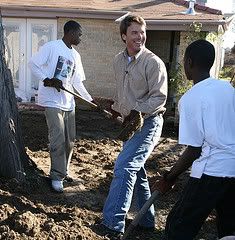
Faith, values, poverty, and politics
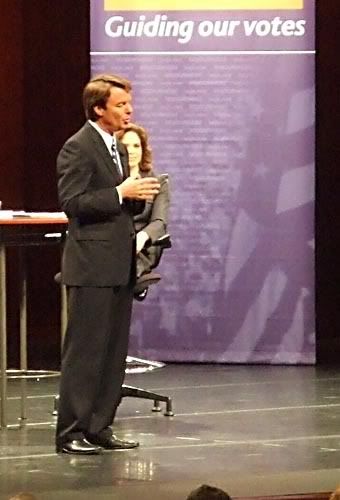
Like many Democrats, I'm a strong believer in separation of church and state. I'm not personally religious in an organized way, and too much mixing of religion and politics makes me very nervous. At the same time, I recognize that it is absolutely proper for people to act out of their own sense of values. What else are they supposed to do? I went to the Sojourners presidential forum on faith, values, and poverty, on Monday, with some trepidation and a little fascination.
I suppose if I were a different person, perhaps a less skeptical person, I might be a member of Sojourners. I certainly share at least some of their political values.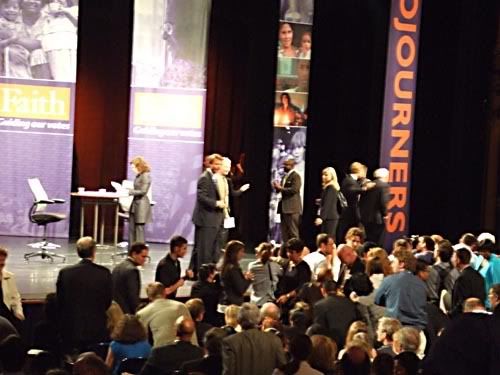
The leader of Sojourners, the Reverend Jim Wallis, and its members, are showing leadership on the issue of poverty. They are currently running a campaign called Vote out Poverty, and Monday's presidential forum, to which they invited presidential candidates John Edwards, Hillary Clinton, and Barack Obama, was just one example of their positive activism on this issue.
Wary as I am of organized religion, I nevertheless have great respect for Sojourners. I get their e-mails, and I attended their presidential forum. In the interest of full disclosure, because of John Edwards's leadership on poverty, as well as his leadership on other issues, I am a dedicated Edwards supporter, so I went into this experience with a clear bias.
If I were to interpret my life the way I think many religious people do, if I were to believe, for instance, that "The hand of God today is in every step of what happens with me and every human being that exists on this planet," as John Edwards said at the presidential forum, I think I would have to say that God took very good care of me that day.
Everything that I needed that day was somehow provided. That includes everything from very minor things, like lunch, to finding the right people to give me an overflow ticket and get me into the forum, when I arrived a few minutes late and the doors were already locked. It even included a very nice seat neighbor whose conversation helped put me at ease in a crowd where I didn't feel totally at home.
This man sitting next to me, a Republican, boasted to me about his pride in his son, who would soon be attending George Washington University and was working with the Young Democrats there. He told me "Faith is interdenominational. So is politics." He also told me he was "sick and tired of a president who thinks God is talking to him, but answers to no one."
He pointed his son out to me. The son was sitting in the front row, in the center. We watched as Elizabeth Edwards, entering the room to an enthusiastic round of applause, paused to pose for a picture with his son.
On further reflection, it's not that I disagree with the Edwards quote about the hand of God, it's just that I'm wary of becoming too cozy in a belief system. I can't help but ask, if God gets involved in human affairs, what exactly is He or She thinking? The only answer I can come up with for that, for myself, at least the only one that allows me to have any faith at all, is that God must think it's time for us to grow up and handle our own affairs. So I figure it's my responsibility to take action to fight the wrongs I see in the world.
Soon, the forum began and Reverend Jim Wallis was introduced. He said that the theme of the evening was faith, values, and with a special focus on poverty. He said there would be no endorsements, and that "the people of God should never be in the pocket of any party or candidate." Sojourners will have a Republican forum in the fall.
My response to Reverend Wallis's quote about the people of God is that I don't think I know anymore if I'm a person of God, I'm confused on that subject, but in any case, a moral leader like John Edwards can certainly borrow me at a time in our history when our country and the world is in this much trouble, and he is the only one running for president who is ready to lead.
Getting on with the forum, Wallis introduced their campaign to "vote out poverty," the goal of which is to make sure "the least of these," who are always forgotten in politics, are not forgotten this time. Good. I like that approach. I know my candidate likes that approach. We are all on the same page on this issue.
I'm not going to talk about the questions each candidate was asked point for point. If you want to read the transcript, you can find it here.
Since I've already revealed my bias, I'm not going to pretend to be objective, either. I am going to tell you exactly what I think.
Keep in mind that these are my personal opinions, and also that I'm coming from a very different perspective than probably most of the people who attended the forum. Personally, I don't care if a candidate is religious. I don't equate religion with morality.
If they are religious, however, I care about their statements on faith. I want to avoid ever again having the president of the United States be a delusional paranoid with a messiah complex. Fortunately, I think all of the Democratic candidates pass that test. None of their comments on faith gave me reason to think that any of them are out of their minds. That's a relief.
While we are on the subject of the candidates answers on faith, let's talk about that some more. I'm also going to talk about my perceptions on the question of any possible pandering to a religious audience that is looking for a religious candidate.
Edwards didn't pander. If he were pandering, he might have said he believed in creationism, but he said he believed in evolution.
JOHN EDWARDS (D), PRESIDENTIAL CANDIDATE: I believe in evolution.
O'BRIEN: What do you say to all the people -- and there are millions of people who go to church every Sunday and who are told very clearly by their pastors that, in fact, the Earth was created in six days, that it's about creationism? Are those people wrong? Are their pastors wrong?
EDWARDS: No. First of all, I grew up in the church and I grew up as a Southern Baptist, was baptized in the Baptist Church when I was very young, a teenager at the time. And I was taught many of the same things. And I think it's perfectly possible to make our faith, my faith belief system consistent with a recognition that there is real science out there and scientific evidence of evolution. I don't think those things are inconsistent. I think a belief in God and a belief in Christ, in my case, is not in any way inconsistent with that.
If he were pandering, he might have said he didn't believe in separation of church and state.
But I think there's a difference between my belief system and what the responsibilities of the president of the United States are. It is the reason we have separation of church and state.
If he were pandering, he might have said that the United States is a Christian nation.
O'BRIEN: Do you think this is a Christian nation?
EDWARDS: No, I think this is a nation -- I mean I'm a Christian; there are lots of Christians in United States of America. I mean, I have a deep and abiding love for my Lord, Jesus Christ, but that doesn't mean that those who come from the Jewish faith, those who come from the Muslim faith, those who come from -- those who don't believe in the existence of God at all, that they don't -- that they're not entitled to have their beliefs respected. They're absolutely entitled to have their beliefs respected. It is one of the basis for which our democracy was founded.
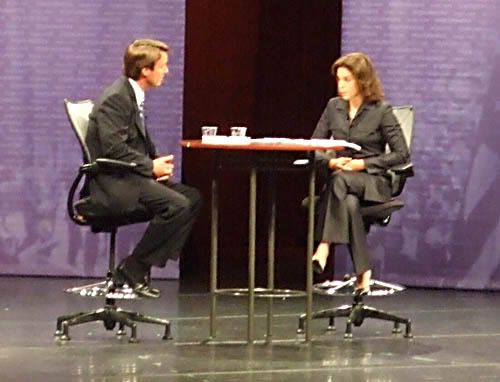
I believe that Edwards said exactly what he thinks, and what he would say to anyone when asked the same questions. I am absolutely comfortable with his answers on his religious beliefs.
Did the others pander? Perhaps. I can't tell that for sure. Maybe what they said was their honest beliefs, but I will tell you my reaction to their comments.
When asked whether God take sides in a war, Obama opened by quoting the exact same Lincoln quote that Edwards quoted in 2004. It's a good quote, and I can't technically say he stole it, since it was Lincoln's quote, not Edwards's, but I thought considering that one of his chief rivals had effectively used it in the last campaign, it showed at the very least a lack of originality.
I thought Obama's comments on faith were mostly fine, and I'm not questioning his sincerity, but I did think he perhaps avoided saying anything that might have been risky in front of that audience, and there were times when I thought he was using nice religious platitudes to avoid getting specific about the issues.
Clinton seemed to spend about half her allotted 15 minutes trying to convince people that she has a faith. She went on and on about how much she relies on her faith and how often she prays. For someone who admitted that she doesn't like to wear her faith on her sleeve, it seemed a sudden transformation, and I thought it was over the top.
I also didn't like her answer on the abortion question she was asked, because I feel certain that she wouldn't give the same answer in front of a pro-choice feminist audience.
REVEREND JOEL C. HUNTER, NORTHLAND, A CHURCH DISTRIBUTED: Hi, Senator Clinton.
Abortion continues to be one of the most hurtful and divisive facts of our nation. I come from the part of the faith community that is very strongly pro-life. I know you're pro-choice, but you have indicated that you would like to reduce the number of abortions.
Could you see yourself, with millions of voters in a pro-life camp, creating a common ground, with the goal ultimately in mind of reducing the decisions for abortion to zero?
CLINTON: Yes. Yes.
And that is what I have tried to both talk about and reach out about over the last many years, going back, really, at least 15 years, in talking about abortion being safe, legal, and rare. And, by rare, I mean rare.
I can agree with the goal of abortion being safe, legal, and relatively rare. I think it's unrealistic, however, to have a goal of zero decisions for abortion, at least until a lot of other problems are solved. I'm talking about problems like imperfect birth-control, imperfect self-control, lack of care for unwanted or parentless children, rape, serious medical complications in pregnancy, and overpopulation. I think until all of those problems are solved, there will be some decisions for abortion, and I'm glad that women have the option to make that choice.
If Clinton thinks that zero decisions for abortion should be the "ultimate" goal, after all those questions are solved, that's one thing. My problem with her answer then becomes that it would've been courageous of her to say so more clearly, but she didn't. I just don't believe that she would say in front of a pro-choice feminist audience that she has a goal of zero decisions for abortion. In this case, I personally think she was pandering.
Let's move on to the special topic of the presidential forum, poverty.
Here are excerpts from all three candidates statements on poverty that were posted by Sojourners on YouTube:
Personally, it came as no surprise to me that Edwards was the only candidate who sounded like he knew what he was talking about on the issue of poverty. He's the only one who has been consistently talking about this issue, and he talks about it everywhere he goes. He has laid out a detailed plan for eliminating poverty in the United States in the next thirty years. He has done serious research and work on the issue. As he said in the forum:
EDWARDS: Well, let me first say thank you to you, Jim, and to Sojourners for its great leadership on this, what I think is a great moral issue facing this country today and I would add to that, this the is the cause of my life. It is the reason after the last election that I went back to the University of North Carolina Chapel Hill, started a poverty center. It is the reason I've traveled around the world doing humanitarian work.
It is the reason I helped lead minimum wage campaigns in six states. It's the reason I've helped organize thousands of workers into unions. And before we ever got into politics, it's the reason that I was involved with urban ministries, faith-based groups, doing work to help the poor and one of the reasons that Elizabeth and I did a lot of other things, starting after school centers for kids who need playgrounds, libraries, et cetera.
So I think there's a very long and consistent pattern of this being the cause of my life. And I might add everything I can do, everything in my power that I'm able to do, I will do to drive the issue of poverty in this presidential campaign so that everyone is required to talk about it. Because I think it is the great moral issue of our time. I've committed, actually, to an agenda of eliminating poverty over the next 30 years.
I think it's a completely achievable agenda. There are lots of components to that agenda. Making work pay, having a living wage, making sure that workers can organize themselves into unions, having decent housing for families that don't have it, having true universal health care, helping kids be able to go to college, which is why I started a college for everyone program for kids in a very poor section of eastern North Carolina. And I believe this is an agenda that should be the agenda -- one of the agendas -- part of the agenda of the president of the United States, so there's not much doubt about where I am on this issue.
I have respect for my colleagues who are running for the presidency, but I will say this is not an issue -- and I say this to everyone in the audience. This is not an issue that I just talk about when I come to you. This is an issue I talk about all over America in front of all kinds of audiences because it's part of who I am. It's who I am as a human being. And I will say this. This is such a part of my life that whatever happens in this presidential campaign, as long as I am alive and breathing, I will be out there fighting with everything I have to help the poor in this country. I can promise you that.
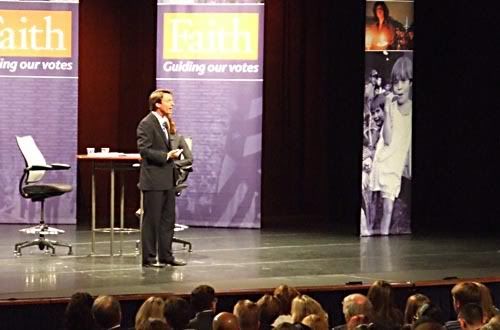
When Obama's turn to talk about poverty came up, Jim Wallis asked him the following question:
If you were the president, what kind of moral and political imagination would you bring to finding some real solutions? And try and give us some specifics.Obama spent what seemed to be at least half of his 15 minutes on this question. For most of that time, he wove sweet rhetoric based on religious ideals, with no policy specifics at all. Toward the very end, he did mention a few semi-specific ideas on education, raising the minimum wage, and giving ex-offenders a second chance. I was glad he had at least a few ideas, but it was hardly impressive.
The last question he was asked, which he almost didn't have time to answer, because he had spent so much time on what seemed to me to be platitudes, was about outrageous executive salaries. Here is the question and answer in its entirety:
O'BRIEN: I know. I get it. But you have one minute left to answer this question. It's an online question from Sojourners, and we actually are obligated to ask this. They invited online support, and the question came from Reverend T. Randall Smith. He's a senior pastor at Deer Park United Methodist in Deer Park, Texas. He asked this: "Executive salaries are increasing by 300 percent in recent years. Ordinary workers' salaries remain stagnant."
Specific policies -- and you have one minute. How do you address that, haves and have-nots?"
OBAMA: Well, we've got a bill in right now that says at minimum, shareholders should take a look at these executive pay scales, and they should be able to vote on whether these are appropriate or not. That I think would provide some constraint.
I also would like to see executives recognize that when they're getting as much in one day as their average worker is getting in an entire year, that there is a moral element to that. That that's problematic.
(APPLAUSE)
OBAMA: But look, America is a land of success, and that's terrific. We just want to make sure that people are sharing in the burdens and benefits of this global economy.
Unbelievable. His answer on the problem of obscene executive salaries is that shareholders should vote on them, and that executives should just not be greedy. Yeah. That sounds like a viable solution. Since executives are often the largest shareholders, is voting on executive pay really going to be effective? And asking corporate executives just to decide not to be greedy is not a solution at all.
Clinton was not asked any direct question about poverty, so perhaps it's not fair to complain that she didn't talk about it. Knowing that it was of primary concern in that forum, however, she should have found a better way to work something in. In fact, the only poverty related issue that she spoke on was health care. This is the extent of her comments on that issue:
Take health care. I think we could get almost unanimous agreement that having more than 45 million uninsured people, nine million of whom are children, is a moral wrong in America. And I think...
O'BRIEN: One minute, Senator.
(APPLAUSE)
O'BRIEN: One minute, Senator.
CLINTON: I think we could reach that agreement, and then we would have to start doing the hard work of deciding what we were going to do to make sure that they were not uninsured, because an uninsured person who goes to the hospital is more likely to die than an insured person. I mean, that is a fact.
So, what do we do? We have to build a political consensus. And that requires people giving up a little bit of their own turf, in order to create this common ground.
Perhaps if Senator Clinton had not spent so long trying to prove that she was a good Christian, she might have found time to talk about poverty.
I can't tell how the Sojourners audience reacted to all of this, because I'm not sure I know. I know that they applauded very enthusiastically for all the candidates. They were an extremely appreciative audience. I hope that their questions about the candidates were answered.
I enjoyed the forum very much. The questions were different than the ones that are usually asked. The responses were interesting. I didn't expect it to change my mind, and it didn't. It was not surprising to me in any way that in a forum that was at least partially about poverty, John Edwards shone.
The nice man sitting next to me, the Republican, told me after the forum was over that he had seen a physical transformation in John Edwards over the past three to four months. He said that now John is looking much more presidential.
Labels: 2008, barack obama, democrats, faith, God, healthcare, hillary clinton, John Edwards, poverty, prayer, president, religion, sojourners, spirituality
posted by Laura Serena at
6/06/2007 03:41:00 PM
|
0 Comments