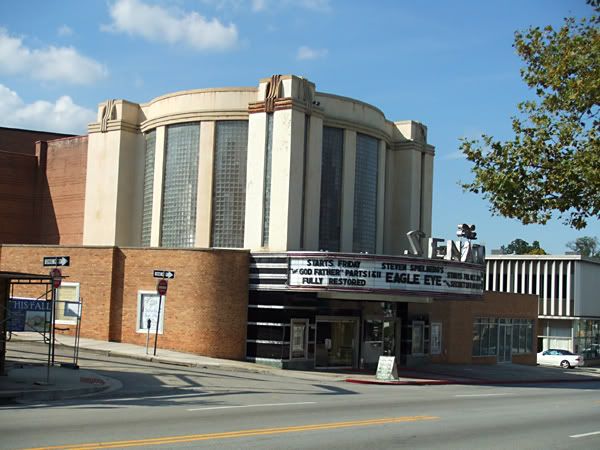
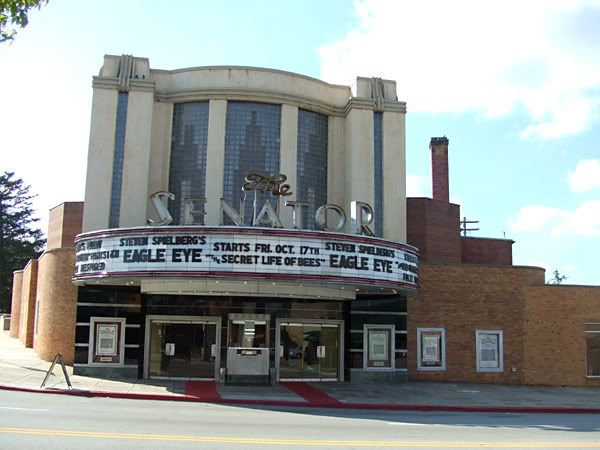
Observing from beyond the solar system, a cultural outsider looks in.

Wednesday, December 29, 2010

What’s Right With This Picture?

The other afternoon before dinner, I approached the gorgeous historic theatre with my family, walking under the beautiful marquee. After standing in line briefly at the box office, we purchased our tickets to a popular current film at a member’s discount.

The membership to the non-profit theatre had been a Christmas gift from my mother – one I had requested. My recent experience with Baltimore City’s inept and clueless handling of The Senator Theatre had made me all too aware of just how precious the other historic theatre in my life actually is.

We strolled into the outer lobby of the theatre, where an usher took our tickets. We stood in line for concessions, and were quickly served fresh popcorn with real butter, delivered in paper buckets and not bags. Passing through another set of doors, we strolled into the glittering inner lobby of the theatre, all of its gilding and original decorations looking stunning, as they always have for many years now.

Walking into the fully restored original auditorium, we found an open row of seats in front of the overhanging balcony. The gilding on the ceiling shone and dazzled as the organist played live music on the theatre’s period organ before the show.

My family and I had arrived at the most stunning entertainment venue in Southeastern Michigan – the Michigan Theater in Ann Arbor, Michigan – for a matinee showing of “The King’s Speech.”

The Michigan Theater was built in 1928 by the W.S. Butterfield Company, a regional theatre chain. It is now owned by a non-profit that uses memberships and donations to supplement its ticket sales and keep the restored theatre in prime condition. Hundreds of historic theatres across the nation are best served by non-profit ownership, which can raise the funds to keep the expensive buildings as beautiful as they were designed to be. Theatres like the Michigan often receive around 40% of their funding from donations and memberships, not ticket sales – an important consideration in today’s economic climate of dwindling attendance for films in theatres.

The Michigan’s schedule is a mix of high-quality, critically acclaimed new films, classic films, live music and other special events, and even the occasional blockbuster. Laurie Anderson and Lyle Lovett & John Hiatt will all appear there in January. Lewis Black will be there and the theater will also host a Charlie Chaplin film festival in February. Jeff Beck will appear there in March.

All in all, the Michigan is one of America’s prime examples of historic theatre ownership and operation done right. It should serve as a model for what The Senator Theatre should become, if only the input and advice of experts in the field would be sought and heeded.

I’ve described the Michigan in some detail above, primarily because I think Baltimoreans who have not been to a successfully restored non-profit theatre like it have often had a difficult time envisioning such a thing. No such thing exists in Baltimore, after all. In other cities, like Ann Arbor, however, such theatres are magnificent and thriving cultural assets.

Almost every little thing is perfect at the Michigan, but not quite. As I left the theater and looked back at the lit marquee, I noticed that just a few of the tiny little light bulbs surrounding the name of the theater were out. Just a few, and they’re those tiny little pain in the butt light bulbs that were so numerous on theatres of the Michigan’s vintage (older than The Senator). Really a major task to keep them all lit at the same time. The bulbs are tiny and there are hundreds of them, so it’s almost a given that a few will always be out on any theatre of that vintage.

Even so, I smiled to myself as I reflected that if my friend Tom Kiefaber were responsible for that marquee, he would not rest for a moment until each tiny light bulb was lit. Anal retentiveness, thy name is Tom.

Perhaps the lesson here is that, even if a city has the foresight and vision to do the right thing with its historic theatre, and even if it has enough funding to take care of the major restoration, it still helps to have an uncompromising, obsessive person or persons with a real passion for the theatre – people like former Senator owner Tom Kiefaber – if every little thing is going to be truly perfect, at least most of the time.

Sadly, this reminded me that the new for-profit operators of The Senator Theatre have been badly neglecting its marquee and its neon – allowing nearly half of the much larger, less numerous light bulbs under it to burn out over the past couple of months, neglecting to keep the neon behind the glass bricks lit, even allowing the neon letters to go out so that, last time I passed by The Senator at night, the letters read SE—TOR, and not The Senator. Tom Kiefaber would never have allowed this neglect of easily maintained key features of the exterior for even one day, if it was humanly and financially possible to repair them. The new operators have been neglecting these simple repairs for months now.

But unlit neon and neglected changes of light bulbs are not the worst of the new operators’ problems. Attendance at the theatre has not improved much since they took over, although they got a temporary boost from all the publicity surrounding the reopening. That means the basic underlying economic problem is still there.

It should be no surprise that people are not going to flock back to The Senator in attendance numbers to rival the 1940s, but somehow Baltimore City has been slow to grasp this fact. In fact, I recently ran across a Daily Record article from April, 2009, in which then Deputy Mayor Andrew Frank is quoted as saying “At its peak [the Senator] drew 350,000 people a year, and that’s the goal we’re trying to get back to.” Uh, Mr. Frank? There are 365 days in a year. That works out to almost 1,000 people a day. Hate to break it to you, but that’s not happening again with first-run films. NOT. EVER. AGAIN. This is quite a revealing quote, however, that shows one of the totally erroneous assumptions on which the City has based their handling of this matter.

To make matters worse, the new operators’ poorly-defined, ill-advised, and preservation-insensitive plans for renovation were rightly rejected recently by the Maryland Historical Trust, the state authority that determines the award of state historic tax credits, based on the national standards for historic preservation that have been set by the U.S. Department of the Interior. The rejection of the sub-standard plans is a huge opportunity to revisit the overall plans for the future of The Senator and course-correct a scheme that has gone badly awry from the beginning. Now is the time to do what should have been done in the first place, and consult historic theatre preservation and redevelopment experts, not just about the plans for renovation or restoration, but about the whole overarching plan.

Unfortunately, though, Baltimore City government is poised to bungle this again, as they may just continue to push through the existing plan, which has already gone so badly awry in just a few months. Outside experts need to be brought in, and they need to be brought in now, if we are to avoid the further slow decline and probable eventual destruction of The Senator Theatre.

Personally, I’d advise starting with a little research into the hundreds of theatres like the Michigan, all across the country, that are doing this right.

Labels: , , , , , , , , , ,

Saturday, July 25, 2009

Akira Kurosawa's Rashomon HELD OVER!

Is this your last chance to see a movie at The Senator?

Held Over @ The Senator Theatre Through Thursday, July 30th
By Popular Demand!

Presented with a stunning digitally restored 35mm print

The husband, the wife... or the bandit?

"Rashomon (1950) struck the world of film like a thunderbolt."
Rober Ebert - Chicago Sun Times

Starring:
Toshiro Mifune, Machiko Kyo, Masayuki Mori, Takashi Shimura, Minoru Chiaki & Kichijiro Ueda

Friday, July 24th and Saturday, July 25th
showtimes: 3:45, 5:45, 7:45 & 9:45pm

Sunday, July 26th showtimes:
3:45, 5:45 & 7:45pm.

Monday, July 27th Through Thursday, July 30th
showtimes: 5:45 & 7:45pm.

Admission $8

A heinous crime and its aftermath are recalled from differing points of view.

Running Time For "Rashomon":
Approx. 1hr and 30min.

The Restoration

The basis for this stunning new restoration was a 35mm print created in 1962 from the original camera negative; while the print itself was in good physical condition, the source material from which it was made was extremely battered. Due to the extensive printing and handling it had received over its lifetime, many shots were already starting to shrink and wrap, and there were numerous scratches, dust, and dirt in the damaged negative. Scanned at 4k resolution, that 47-year-old print has
been meticulously cleaned both digitally and by hand, complete with a new seamless soundtrack.

This essential restoration has been made possible by the Academy Film Archive, the National Film Center of the National Museum of Modern Art, Tokyo, and Kadokawa Pictures, Inc., with funding provided by Kadokawa Cultural Promotion Foundation and
Martin Scorsese's Film Foundation.

Is this your last chance to see a movie at The Senator?

Frankly, I don't know.

Baltimore City was the highest bidder in a confusing auction on Wednesday, where chaos was created by the auctioneer changing the venue of the auction from inside the theatre to outside with less than 5 minutes notice.

Ownership of the theatre will not actually change until the auction is ratified in court, which I understand will take at least 30 days.

Who knows? Maybe the next auction will have a better result.

In any case, what the future holds is unclear, and I am unaware of any more events scheduled at the theatre in the near future, although it's possible more events could be in the works.

Labels: , , , , , , , , ,

Wednesday, October 08, 2008

Flicks Files Flash: "The Godfather" Restored

Monday night, I was invited to a special premiere showing of the newly restored version of Francis Ford Coppola's classic film The Godfather at the Senator Theatre in Baltimore, one of five "historic presentation" theaters in the country chosen to showcase the restored versions of this film and The Godfather, Part II.


At the request of director Francis Ford Coppola, the 1972 film has been restored in what sounds like a meticulous and painstaking process by film preservation expert Robert A. Harris.

Paramount delivered the film’s surviving elements — original camera negative, YCM separation masters, intermediate separation masters and thousands of feet of miscellaneous elements — to Pro-Tek Preservation Services in Burbank, where an inspection confirmed that radical surgery was required. Held together with tape, the original negative was filthy and riddled with scratches, rips and tears, some of which broke into the image area; in some sections, parts of the image had actually been torn away.


According to Senator owner Tom Kiefaber, Harris was very impressed with the Senator on a previous visit, when the theater showed his restoration of Lawrence of Arabia, and it was Harris who suggested that the Senator be one of the theaters allowed to show this new restoration of The Godfather.

The two Godfather films begin showing at the Senator on Friday, October 10, but I got invited to the free private screening Monday night, because I am on the Senator's mailing list. If you live in the Baltimore area, this should be reason enough for you to go to the Senator's website and sign up to be on their mailing list yourself.

I feel a little silly reviewing this film, because it is routinely listed among the best American films ever made, and probably there is nothing I can say about it that hasn't been said before. The Godfather came out when I was very young, and I've been hearing people talk about it for at least the last 30 years. Usually what they say is it's exceedingly good or exceedingly violent, or both.

I, however, had never seen it, and that was for one reason only --- I don't like violence. I'm not a puritan about it, and I don't always succeed in avoiding violent movies. America has an obsession with violence, and much as I hate it, it's part of our culture. I sometimes end up seeing movies I know are violent if the subject interests me for other reasons, if I like the actors or the director, if the violence is cartoonish and bloodless, or if the movie gets so much praise that it must be a real work of art. The Godfather falls into that last category, so when I got a chance to see the restored version on the big screen, I decided to put aside my natural revulsion to the subject and go see it.

This is the story of an organized crime family, the Corleone family, and their various disagreements and vendettas against other Italian mob families. In it, an attempted hit against Vitto Corleone, the Godfather, begins a series of violent repercussions and revenge. These are guys you don't cross, and if you do, bad things happen to you.

Having heard this movie built up for 30 years or more, it's hard for it to live up to the reputation. In my opinion, this is neither the best movie, nor the most violent that I've seen. But I do have to agree somewhat with the general verdict --- this is a very fine movie. What makes it great is the writing, the characterizations, the compelling performances, and the chilling difference between the tenderness the members of the Corleone family show each other and the way they turn into absolute monsters when handling their "business."

Marlon Brando was superb as the Godfather, Vitto Corleone; Al Pacino was likewise as his innocent-looking young son Michael, who becomes ever more corrupt as the film progresses. Pacino is so young in this film that it took me about half the movie to realize who the actor was. And was that a very young Diane Keaton as Michael's girlfriend Kay? (Yes, it was, but again, it took me a long time to recognize her.)

I'll confess there was one major thing I didn't get about this movie, which kept nagging me throughout. What did the members of these crime families think they were gaining by all this violence? Power, maybe. Wealth, maybe, except they seemed to have little time to enjoy it, and all of their houses looked like funeral parlors. Nobody in the movie seemed to be enjoying life, so where was the benefit of this lifestyle? I just didn't get why these people considered their lifestyle one worth pursuing. Really, they seemed like ugly, mean little people living ugly, mean little lives. Perhaps that was the point.

Ultimately, I think these questions are criticisms of our society, and not of the film. What do we gain by our obsession with violence? Money? It sure doesn't look like it these days. Power? Again, I would question that. Are we enjoying life? Is this making us better? I don't think so.

The special engagement of The Godfather and The Godfather, Part II starts Friday. The movies will play for one week only. The Godfather will play at 12:30 p.m. and 8:00 p.m., and The Godfather, Part II will play at 4:00 p.m. You can see one movie or both for the admission price. If you want to catch the restored prints of these movies on the big screen, now's the time.


In any case, if you live in the Baltimore area, please sign up for the listserv and support the Senator Theatre. It's one of the few classic old movie theaters left, it's beautiful and architecturally unique, and it deserves to be preserved.

The Godfather receives the Pass the Popcorn rating in the black cat rating system, indicating it’s well worth watching.

Labels: , , , , , , , , , , ,